


Scrub pants need to do more than fit around the waist. The correct length, rise, leg shape, and overall proportions can affect how comfortably healthcare professionals walk, bend, sit, and move throughout a shift. Petite, short, tall, and regular-length scrub pants are designed to address different proportions, making inseam and body measurements important when choosing medical workwear.
A properly fitted pair should stay secure at the waist, provide enough room through the hips and thighs, and end at an appropriate point above or around the footwear. Choosing the correct length can also reduce excess fabric, bunching, dragging, or repeated adjustments during a busy workday.
Key Takeaways
- Petite scrub pants are generally designed for shorter proportions and often use a shorter inseam and adjusted overall dimensions.
- Short scrub pants provide a shorter inseam without necessarily changing every other proportion of the garment.
- Tall scrub pants provide additional length for professionals who need a longer inseam.
- Regular-length scrub pants are designed around standard proportions and may work well when the standard inseam fits correctly.
- Inseam should be evaluated together with rise, waist, hips, thighs, and leg shape.
- A correct length should allow comfortable movement without excessive fabric collecting around the ankles or dragging on the floor.
- Jogger, tapered, straight-leg, and cargo styles can fit differently even when the listed inseam is identical.
- The best size should be selected using the manufacturer’s measurements rather than relying only on the size normally worn.
- Workplace dress codes should be checked before choosing colors, silhouettes, or specialty styles.
The site research identifies dedicated categories for petite-length, tall-length, short-length, and regular-length scrub pants, making length-specific workwear an important part of the site’s scrub-pant category structure.
Why Does Scrub Pant Length Matter?
Scrub pants are worn during long periods of standing, walking, sitting, bending, and other routine movements. An incorrect inseam can make an otherwise well-fitting pair uncomfortable or impractical.
Pants that are too long may:
- Bunch around the ankles
- Drag against the floor
- Catch against footwear
- Collect excess fabric
- Become more difficult to move in
- Look oversized
Pants that are too short may:
- Expose too much ankle
- Ride upward during movement
- Feel restrictive around the lower leg
- Provide less coverage than expected
- Look disproportionate with certain scrub tops
The goal is not simply to find the shortest or longest available option. It is to find a length that works with the wearer’s proportions, footwear, leg shape, and daily activities.
What Are Petite Scrub Pants?
Petite scrub pants are designed for shorter body proportions rather than simply shortening a regular pair of pants.
Depending on the manufacturer, petite construction may involve adjustments to:
- Inseam
- Rise
- Knee placement
- Leg proportions
- Overall garment length
This distinction matters because simply shortening a regular-length pant does not necessarily reposition every part of the garment.
For example, the knee area on a regular pant may sit too low even if the hem is altered.
Who May Benefit From Petite Scrub Pants?
Petite sizing can be useful for healthcare professionals who find that regular scrub pants are consistently:
- Too long
- Too low at the knee
- Too long through the rise
- Excessively roomy through the lower leg
Height alone does not determine whether petite sizing is appropriate.
Two people with the same height can have different:
- Leg lengths
- Torso lengths
- Hip proportions
- Rise measurements
Body measurements and garment fit are therefore more useful than height alone.
What Are Short-Length Scrub Pants?
Short-length scrub pants primarily address inseam length.
They can be useful for someone whose:
- Waist fits correctly
- Hip measurement fits correctly
- Rise feels appropriate
- Leg shape works well
but whose regular inseam is simply too long.
This makes short sizing different from petite sizing.
A short-length version may maintain more of the standard garment’s proportions while changing the overall leg length.
When Should You Choose Short Instead of Petite?
Consider short sizing when the regular garment otherwise fits well but the hem is too long.
Petite sizing may be more appropriate when multiple proportions feel too long or oversized.
The exact distinction varies by manufacturer, so always review the individual size chart.
What Are Tall Scrub Pants?
Tall scrub pants provide additional length for professionals who need a longer inseam.
They can help address:
- Exposed ankles
- Excessive upward movement
- Pants ending above the preferred footwear position
- Insufficient lower-leg coverage
Tall sizing may also adjust other garment proportions depending on the manufacturer.
Who May Need Tall Scrub Pants?
Tall sizing may be useful for professionals who regularly find that regular-length scrub pants are:
- Too short
- Sitting above the desired ankle position
- Pulling upward during movement
- Difficult to wear with preferred footwear
Again, height alone is not enough to determine the correct size.
A person’s inseam is usually a more direct measurement for pant length.
What Are Regular-Length Scrub Pants?
Regular-length scrub pants are intended for standard garment proportions.
They can work well when:
- The inseam matches the wearer
- The rise feels comfortable
- The waistband stays secure
- The hips and thighs have appropriate room
- The leg opening works with the footwear
Regular length does not mean universally correct.
A person may be average height but still need short or tall pants because leg-to-torso proportions vary.
Petite vs Short Scrub Pants: What’s the Difference?
The terms are sometimes used differently between manufacturers.
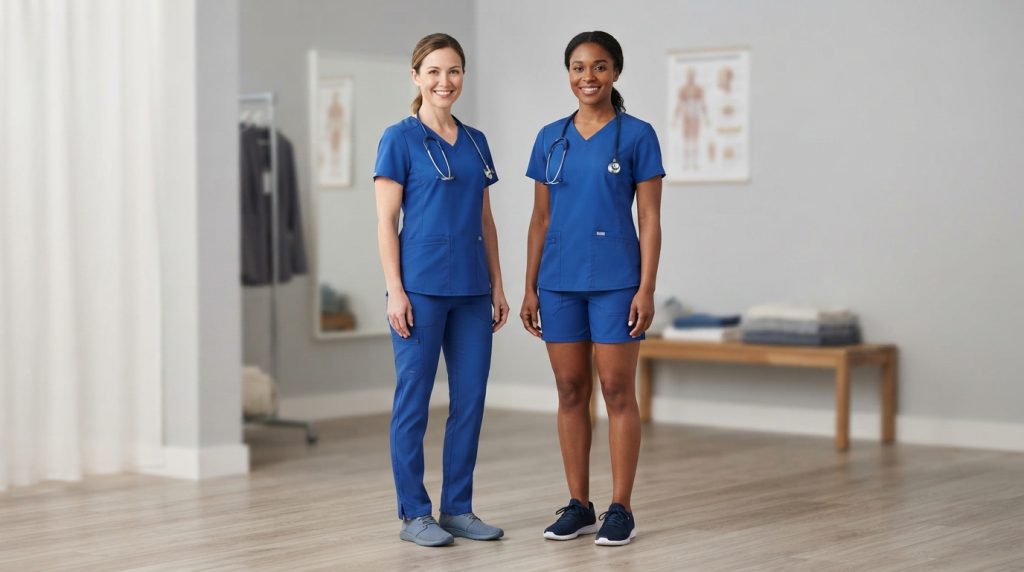
As a general fit concept:
| Feature | Petite | Short |
| Primary Purpose | Shorter overall proportions | Shorter inseam |
| Inseam | Usually shorter | Usually shorter |
| Rise | May be proportionally adjusted | May remain closer to regular |
| Knee Placement | May be repositioned | May remain closer to regular |
| Overall Shape | Designed for shorter proportions | Primarily length-focused |
| Best Starting Point | Multiple proportions feel long | Regular fit works except for length |
Always check the manufacturer’s measurements because sizing terminology is not completely standardized.
How Do You Measure Scrub Pant Inseam?
The inseam is measured from the crotch area down the inside leg to the bottom of the hem.
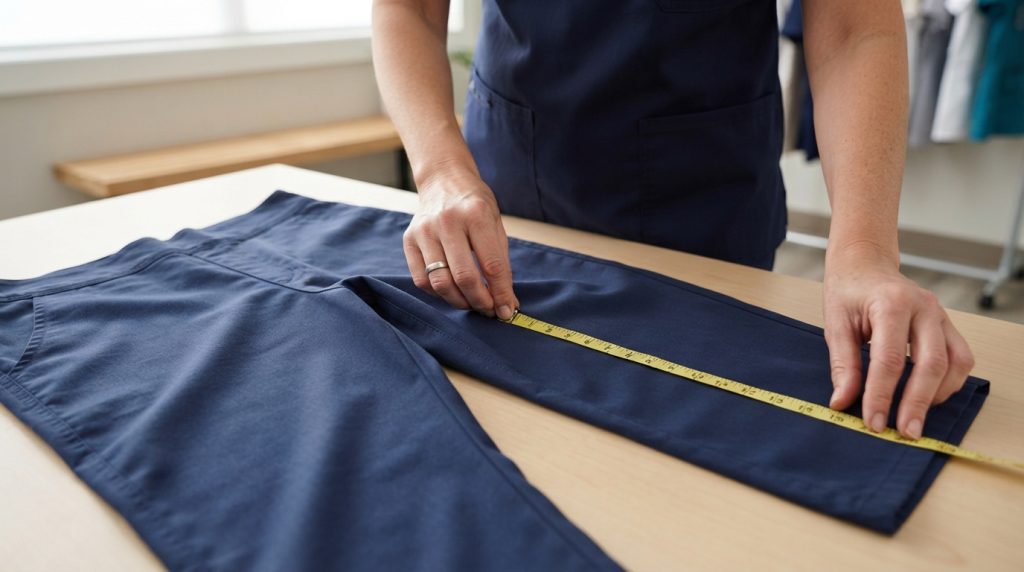
One practical method is to use a pair of pants that already fits correctly.
Measuring an Existing Pair
- Lay the pants flat.
- Smooth the fabric without stretching it.
- Locate the crotch seam.
- Measure along the inside leg.
- Continue to the bottom of the hem.
- Record the measurement.
Compare that measurement with the scrub pant manufacturer’s size chart.
Why Measure an Existing Pair?
A favorite pair provides a practical reference because it already reflects:
- Preferred length
- Preferred footwear
- Personal styling
- Comfortable movement
However, different fabrics and silhouettes can sit differently, so the measurement should be treated as a starting point rather than an absolute rule.
Should Scrub Pants Touch the Floor?
Generally, scrub pants should not drag on the floor.
Excessively long pants can:
- Collect dirt and debris
- Catch on footwear
- Become damaged at the hem
- Create unnecessary fabric around the feet
The appropriate hem position depends on:
- Pant silhouette
- Footwear
- Workplace expectations
- Personal preference
The goal is a controlled hem that provides appropriate coverage without dragging.
How Should Scrub Pants Fit Over Work Shoes?
Always evaluate scrub-pant length with the shoes normally worn during work.
A hem can appear too long with low-profile shoes but appropriate with a slightly higher sole.
Similarly, changing footwear can alter how joggers or straight-leg pants sit.
Test the Complete Uniform
Put on:
- Scrub top
- Scrub pants
- Normal socks
- Regular work shoes
- Scrub jacket if normally worn
Then walk and sit.
Check the hem from the front, side, and back.
How Should the Rise Fit?
Inseam is only one part of pant fit.
The rise is the distance between the waistband and crotch area.
A correct rise should allow comfortable:
- Sitting
- Walking
- Bending
- Reaching
- Standing
Signs the Rise Is Too Short
Look for:
- Pulling through the crotch
- Waistband being pulled downward
- Reduced back coverage
- Strong tension while sitting
- Restricted hip movement
Signs the Rise Is Too Long
Possible signs include:
- Excess fabric under the crotch
- Dropped crotch position
- Bunching
- Difficulty positioning the waistband
- Pants shifting during walking
A different size may not solve the issue if the underlying cut is wrong for the wearer’s proportions.
How Should Scrub Pants Fit Around the Waist?
The waistband should remain secure without excessive pressure.
It should not require constant adjustment.
Depending on the style, common waistband constructions include:
- Elastic
- Full elastic
- Partial elastic
- Drawstring
- Yoga-style waistband
- Elastic and drawstring combinations
Drawstring Waistbands
Drawstrings can provide additional adjustment.
However, the drawstring should not need to be pulled extremely tight to prevent the pants from falling.
If it does, the underlying size or cut may not be appropriate.
Full Elastic Waistbands
Full elastic construction can provide flexibility throughout the waist.
Check that the elastic does not:
- Dig into the skin
- Roll
- Twist
- Lose recovery
Yoga-Style Waistbands
Wider waistbands can distribute pressure across a larger area.
They may also create a smoother transition under a scrub top or jacket.
Comfort depends on the specific construction.
How Should Scrub Pants Fit Through the Hips?
The hips should have enough room for comfortable movement without excessive fabric.
Pants may be too tight when:
- Side seams pull
- Front pockets open
- Fabric remains stretched
- Walking feels restricted
- The waistband is pulled downward
Pants may be too loose when:
- The seat sags
- Fabric gathers excessively
- The pants shift while walking
- The crotch hangs too low
Sizing should accommodate the largest relevant measurement rather than forcing one area into an unsuitable size.
How Should Scrub Pants Fit Through the Thighs?
Healthcare work can require frequent movement through the hips and legs.
The thigh area should allow:
- Walking
- Sitting
- Squatting when appropriate
- Bending
- Climbing stairs
- Normal stride length
A tapered pant can feel substantially different from a straight-leg pant even when both have the same waist and inseam measurements.
Test Movement
Stand naturally and then:
- Walk several steps.
- Sit down.
- Stand up.
- Bend comfortably.
- Take a longer step.
- Check whether the fabric pulls.
The pants should move with the body rather than requiring repeated adjustment.
How Does Leg Shape Affect Scrub Pant Length?
Leg silhouette changes how the hem appears.
Common scrub-pant silhouettes include:
- Straight leg
- Tapered leg
- Jogger
- Cargo
- Bootcut or flare
A narrow ankle opening can make excess length more noticeable because fabric may collect above the cuff.
A straight-leg pant may distribute extra length differently.
The inseam number alone therefore does not tell the entire fit story.
How Do Jogger Scrub Pants Fit Differently?
Joggers usually taper toward an elastic or knit cuff.
The cuff can help keep the hem controlled around the ankle.
Potential advantages include:
- Less loose fabric
- Modern silhouette
- Secure ankle position
- Easy pairing with work shoes
However, check the cuff itself.
It should not be so tight that it:
- Restricts the ankle
- Leaves a visible pressure mark
- Becomes uncomfortable after prolonged wear
The site inventory includes both regular-length and specialty-length scrub-pant options, including jogger styles, showing why silhouette and length need to be considered together.
How Do Straight-Leg Scrub Pants Fit Differently?
Straight-leg pants maintain a more consistent width from thigh toward hem.
They may offer:
- Traditional styling
- More calf room
- A less tapered appearance
- Easy compatibility with various footwear
Length remains important because extra fabric can collect around the shoe.
How Do Tapered Scrub Pants Fit Differently?
Tapered pants gradually narrow toward the ankle.
They can provide:
- Streamlined appearance
- Reduced lower-leg fabric
- Modern silhouette
The wearer should check the calf and ankle area separately from the waist and hip.
A pant can fit correctly at the waist while feeling too narrow below the knee.
How Do Cargo Scrub Pants Fit Differently?
Cargo pants add storage through thigh-level pockets.
They can be useful for professionals who need additional lightweight storage.
However, cargo pockets can influence how the garment hangs.
Heavy contents may:
- Pull the pants downward
- Distort the pocket
- Change the silhouette
- Increase leg movement
Pocket capacity should be considered alongside overall garment weight.
Does Fabric Stretch Affect Scrub Pant Sizing?
Yes.
Stretch can provide additional movement room without requiring a much larger garment.
Common stretch fibers include:
- Spandex
- Elastane
A fabric with useful stretch may make it easier to:
- Bend
- Sit
- Walk
- Reach
- Squat
However, stretch should not be used to justify buying an undersized garment.
The fabric should return toward its original shape after movement.
Why Is Stretch Recovery Important?
Stretch recovery refers to how well fabric returns toward its original dimensions after being extended.
Poor recovery may lead to:
- Bagged knees
- Loose waistbands
- Sagging seat
- Distorted pockets
- Permanently stretched fabric
A pant that feels comfortable for five minutes may not perform the same way after several hours.
What Fabric Weight Should Scrub Pants Have?
Fabric weight should match the workplace environment and personal comfort.
Lightweight fabrics can provide:
- Reduced bulk
- Easier movement
- Less warmth
Midweight fabrics can provide:
- More structure
- Additional coverage
- Greater perceived durability
Heavier fabrics may provide warmth but can become uncomfortable in warm clinical environments.
There is no universally correct weight.
Are Breathable Scrub Pants Better?
Breathability can be useful in warm or active environments.
Professionals who spend substantial time walking may prefer fabrics that allow comfortable heat management.
However, very lightweight fabric can sometimes compromise:
- Structure
- Opacity
- Durability
- Pocket support
A balance between airflow, weight, coverage, and durability is usually more useful than choosing the thinnest available material.
How Important Is Pocket Placement?
Pocket placement affects both convenience and garment balance.
Common scrub-pant pockets include:
- Front pockets
- Cargo pockets
- Back pockets
- Zippered pockets
- Hidden compartments
Front Pockets
These are convenient for lightweight items but may become uncomfortable if heavily loaded.
Cargo Pockets
These provide additional storage without occupying the front waist area.
Zippered Pockets
These can help secure small personal items.
The number of pockets should reflect actual work needs rather than simply maximizing storage.
Can Heavy Pocket Contents Change Scrub Pant Fit?
Yes.
A heavily loaded pocket can pull against the fabric and waistband.
This may cause:
- Uneven hem
- Waistband shifting
- Pocket distortion
- Increased garment weight
For safety reasons, contaminated sharps and other hazardous items should never be carried loosely in ordinary scrub pockets. OSHA provides specific guidance on safe handling and disposal of sharps in healthcare environments. OSHA guidance on needlestick and sharps injuries
How Should Petite Scrub Pants Be Tested?
Put on the actual shoes normally worn at work.
Then check:
Standing
Does the hem sit at the desired position?
Walking
Does the fabric remain controlled?
Sitting
Does the pant leg pull upward excessively?
Bending
Does the knee placement feel natural?
Stair Movement
Does the inseam remain comfortable?
Knee placement is particularly useful when evaluating petite sizing because the garment may have been proportionally adjusted rather than simply shortened.
How Should Tall Scrub Pants Be Tested?
Tall sizing should be evaluated for more than hem length.
Check:
- Waist position
- Rise
- Knee placement
- Thigh fit
- Inseam
- Ankle position
A tall pant can have enough length but still feel wrong if the rise or knee position does not suit the wearer.
Check While Sitting
Sit down and check whether the pants pull upward substantially around the lower leg.
Then stand and walk.
The additional length should support movement rather than create excessive fabric.
How Should Short Scrub Pants Be Tested?
Short pants should maintain appropriate proportions while providing a shorter inseam.
Check:
- Waist
- Rise
- Hip
- Thigh
- Knee position
- Hem
If the waist and hips fit correctly but the regular hem is simply too long, short length may be the appropriate category.
When Should You Choose Regular-Length Scrub Pants?
Regular length can be a practical choice when:
- The standard inseam fits
- Knee placement feels natural
- The hem works with work shoes
- The rise is comfortable
- The garment moves correctly
There is no reason to choose petite or tall sizing simply because those categories exist.
Use the category that matches actual measurements.
How Do You Choose Between Petite, Short, Regular and Tall Scrub Pants?
Use a measurement-first approach.
Step 1: Measure the Inseam
Determine the approximate length you need.
Step 2: Measure the Waist
Use the manufacturer’s instructions rather than assuming your usual clothing size.
Step 3: Measure the Hips
This helps identify whether a length-specific size also provides sufficient room elsewhere.
Step 4: Check the Rise
Look at the garment measurements if available.
Step 5: Identify the Leg Shape
Decide whether you prefer:
- Jogger
- Straight leg
- Tapered
- Cargo
Step 6: Consider Footwear
Your normal work shoes affect the final hem position.
Step 7: Review the Size Chart
Use the individual manufacturer’s measurements.
Step 8: Test Movement
Check standing, walking, sitting, bending, and reaching.
This process is more reliable than choosing a size based only on height.
What If Your Waist Fits but Your Inseam Does Not?
This is a common reason to investigate length-specific categories.
For example, a professional may have a waist and hip measurement that fit a regular-size pant while the inseam is consistently too long.
In that situation, a short-length version may provide a better solution than choosing a smaller waist size.
Similarly, someone whose regular pants fit through the waist and hips but repeatedly expose the ankle may need tall length rather than sizing up.
What If You Are Between Two Sizes?
Compare the measurements rather than automatically choosing the larger size.
Consider:
- Waist
- Hips
- Thigh
- Rise
- Inseam
If one size provides the correct waist but the wrong length, investigate whether the manufacturer offers another length within the same general size range.
This is one reason length-specific scrub categories can be useful.
Should Scrub Pants Be Tight or Loose?
Neither extreme is ideal.
Scrub pants should provide enough ease for movement while maintaining a controlled silhouette.
Too Tight
Possible signs include:
- Horizontal pulling
- Pocket openings spreading
- Restricted walking
- Waistband pressure
- Fabric remaining stretched
Too Loose
Possible signs include:
- Excessive fabric
- Sagging seat
- Waistband instability
- Pants twisting
- Bunching around the ankles
The right fit is controlled without being restrictive.
How Should Scrub Pants Fit During a Long Shift?
Fit should be evaluated beyond the first few minutes.

A long shift can expose problems involving:
- Waistband pressure
- Heat
- Fabric bunching
- Knee movement
- Pocket weight
- Ankle restriction
The ideal pair should remain comfortable after extended standing and walking.
Long-Shift Fit Test
Wear the pants during ordinary activities.
Pay attention to whether you repeatedly:
- Pull up the waistband
- Adjust the hem
- Reposition the crotch
- Pull fabric away from the knees
- Empty overloaded pockets
Repeated adjustment is useful feedback that another size, length, or silhouette may work better.
How Should Scrub Pants Work With a Scrub Jacket?
A scrub jacket does not directly change pant length, but it affects overall uniform balance.
A longer jacket can visually alter the proportion between the upper and lower body.
Consider:
- Jacket length
- Pant rise
- Pant silhouette
- Footwear
A fitted jacket may pair differently with a wide straight-leg pant than with a tapered jogger.
The combination should be evaluated as a complete uniform.
How Should Scrub Pants Work With Underscrubs?
Underscrubs generally affect the top half of the uniform more than the pants.
However, additional layers can change overall temperature and comfort.
When evaluating a complete workwear system, consider:
- Pant fabric weight
- Top fabric weight
- Jacket weight
- Workplace temperature
- Shift activity
A lightweight pant can be useful when several layers are worn above the waist.
How Should Scrub Pants Be Washed?
Follow the garment care label.
The Federal Trade Commission’s clothing care-labeling requirements provide consumers with information about appropriate garment care. FTC clothing care-labeling guidance
Before laundering:
- Empty all pockets
- Remove accessories
- Secure drawstrings as directed
- Close zippers where recommended
- Follow washing instructions
- Observe bleach restrictions
- Follow drying instructions
Incorrect heat or washing conditions can affect:
- Inseam
- Waistband elasticity
- Stretch recovery
- Color
- Pocket construction
Can Scrub Pants Shrink?
Some fabrics can change dimensions during laundering, depending on fiber composition and garment construction.
This is another reason to follow the care label.
Do not intentionally shrink scrub pants to correct an incorrect length.
Shrinkage can affect:
- Waist
- Hips
- Rise
- Inseam
- Leg shape
- Stretch panels
It is better to choose the correct length before washing.
When Should Scrub Pants Be Replaced?
A pair may need replacement when it no longer provides appropriate:
- Fit
- Coverage
- Comfort
- Appearance
- Function
Common signs include:
- Stretched waistband
- Damaged drawstring
- Torn pockets
- Split seams
- Permanent knee bagging
- Excessive pilling
- Significant fading
- Fabric thinning
- Persistent stains
- Distorted hem
If the pant has permanently changed shape, replacing it may be more practical than repeatedly adjusting it.
Common Scrub Pant Fit Mistakes
Choosing Based Only on Height
Height does not reveal inseam, rise, or hip proportions.
Assuming Petite and Short Mean the Same Thing
Manufacturers may use these categories differently.
Buying Tall Pants Only Because You Are Tall
Leg length is more relevant than height alone.
Ignoring the Rise
A correct inseam cannot compensate for an uncomfortable rise.
Ignoring Footwear
The same hem can look different with different shoes.
Choosing the Smallest Possible Size
A narrow fit can restrict movement.
Sizing Up to Solve Length Problems
This may create excess width instead of fixing the inseam.
Ignoring Knee Placement
This can be especially noticeable in petite and tall sizing.
Overloading Cargo Pockets
Excess weight can affect the entire garment.
Testing Only While Standing
Sitting and walking can reveal fit problems that are invisible while standing.
Washing Before Checking Fit
Confirm the garment works before committing to laundering or customization when return policies allow.
Buying Several Pairs Before Testing One
A new length or silhouette should be tested before building an entire rotation.
Scrub Pant Length Buying Checklist
Length
- Inseam has been measured
- Hem works with normal work shoes
- Pants do not drag
- Pants do not ride excessively high
- Knee placement feels natural
Waist and Rise
- Waistband stays secure
- Waistband does not dig in
- Rise allows comfortable sitting
- Drawstring does not require excessive tightening
Hips and Thighs
- Walking is unrestricted
- Sitting is comfortable
- Bending is comfortable
- Fabric does not remain under strong tension
Leg Shape
- Jogger cuff is comfortable
- Tapered leg allows adequate calf room
- Straight leg does not create excessive fabric
- Cargo pockets do not interfere with movement
Fabric
- Stretch supports normal movement
- Fabric has appropriate recovery
- Weight suits the workplace
- Coverage is appropriate
- Care requirements are practical
Pockets
- Storage matches actual needs
- Pockets remain stable
- Heavy items are not carried unnecessarily
- Hazardous items are handled according to workplace procedures
Where Can You Check Scrub Pant Length in Person?
Trying on specialty-length scrub pants can be useful when online measurements do not fully communicate how the garment sits.
A medical uniform store in Lincoln can provide an opportunity to evaluate petite, tall, short, and regular scrub pants with the footwear and scrub tops normally worn for work.
In-person fitting can make it easier to compare:
- Inseam
- Rise
- Knee position
- Leg shape
- Waistband
- Fabric
- Pocket placement
How Should You Shop for Scrub Pants Online?
When shopping online, start with measurements rather than product photographs.
For each pair, check:
- Waist measurement
- Hip measurement
- Inseam
- Rise when available
- Leg silhouette
- Fabric composition
- Stretch
- Pocket configuration
- Care instructions
The site’s scrub-pant structure includes dedicated regular, short, petite, and tall categories, which can make it easier to begin with the appropriate length before evaluating individual styles.
Compare Measurements With a Pair You Already Own
If a current pair fits correctly, measure it and use it as a reference.
However, remember that:
- Joggers fit differently from straight legs
- Stretch fabrics behave differently from rigid fabrics
- Different rises change the overall fit
- Different manufacturers may measure garments differently
The size chart for the specific garment should remain the final reference.
Conclusion
Choosing the correct scrub pant length is about more than deciding between short and long.
Petite, short, regular, and tall categories can address different proportion needs, while rise, waist, hip, thigh, leg shape, and footwear all influence the final fit.
A practical approach is to:
- Measure the inseam.
- Check the waist and hips.
- Evaluate the rise.
- Select the appropriate length category.
- Consider the leg silhouette.
- Test the pants with normal work footwear.
- Walk, sit, and bend before deciding.
- Review the care requirements.
The right pair should remain secure without excessive tightening, provide comfortable movement, and end at an appropriate position around the footwear.
For healthcare professionals who have repeatedly struggled with pants that are too long or too short, length-specific scrub categories can provide a more precise starting point than simply changing the overall clothing size.
Frequently Asked Questions
What is the difference between petite and short scrub pants?
Petite scrub pants may adjust several garment proportions for shorter body proportions, while short scrub pants often focus primarily on providing a shorter inseam. Manufacturers define these categories differently, so the individual size chart should always be checked.
How do I know if I need tall scrub pants?
Tall scrub pants may be appropriate when regular-length pants consistently end too high above the ankle despite the waist, hips, and rise fitting correctly. Measuring your inseam and comparing it with the manufacturer’s size chart is a better approach than choosing based solely on height.
Should scrub pants touch the floor?
Scrub pants should generally not drag on the floor. The ideal hem depends on the pant silhouette and footwear, but excessive fabric around the feet can create unnecessary bunching and interfere with movement.
Can I just buy a larger size if scrub pants are too short?
Usually, sizing up is not the most direct solution to a length problem. A larger size may increase waist, hip, thigh, and rise dimensions without providing the desired proportional fit. A tall or longer-length option may be more appropriate.
Are jogger scrub pants better for short or tall people?
Joggers are available in different lengths and can work for various body proportions. The important considerations are inseam, rise, thigh fit, calf room, and ankle cuff. The jogger silhouette itself does not determine whether someone needs petite, short, regular, or tall sizing.
How should scrub pants fit around the waist?
The waistband should remain secure without excessive pressure. It should stay in place during standing, walking, and sitting without requiring constant adjustment or an overly tight drawstring.
Why do my scrub pants fit at the waist but feel wrong at the knees?
The issue may involve the garment’s overall proportions rather than the waist size. Knee placement, rise, inseam, and leg construction can all affect how pants feel during movement. A different length or garment cut may solve the problem better than changing waist size.
Should I measure my inseam before buying scrub pants online?
Yes. Inseam measurement provides a useful starting point for choosing between short, regular, petite, and tall options. Compare your measurement with the specific garment’s size chart because measurements and terminology can vary between manufacturers.