
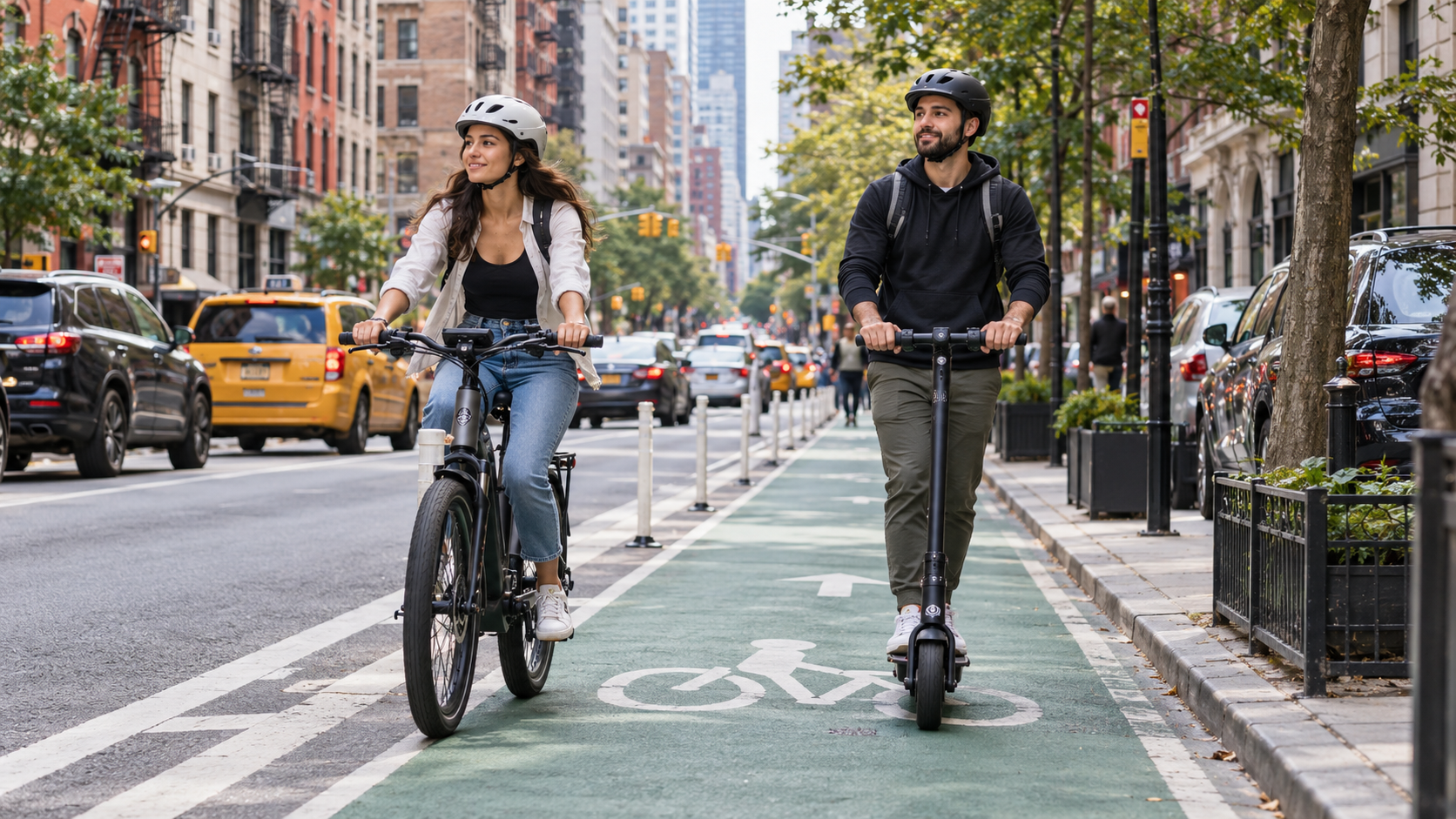
Electric bicycles and scooters have become common transportation options throughout New York. Commuters, delivery workers, students, and other riders use these devices to travel through neighborhoods, bicycle lanes, and busy intersections. However, collisions involving e-bikes and electric scooters can result in serious injuries and complicated legal disputes.
An injured rider, pedestrian, or other road user may have grounds to pursue compensation when another party’s negligence causes or contributes to an accident. Determining responsibility often requires examining traffic laws, the device’s legal classification, insurance coverage, and the circumstances of the collision.
Understanding how e-bike and scooter accident claims work in New York can help injured people evaluate their rights and preserve the evidence needed to support a potential injury claim.
Quick Answer
Can someone file a personal injury claim after an e-bike or electric scooter accident in New York?
Yes. A person injured in an electric bicycle or scooter accident may pursue compensation when another person’s negligence, a dangerous property condition, or a defective product caused or contributed to the injury.
Potentially responsible parties may include automobile drivers, scooter operators, commercial vehicle owners, property owners, rental companies, or equipment manufacturers.
However, compensation is not automatic. The injured person generally must establish a legally recognized duty, negligence or another applicable basis for liability, causation, and damages. Insurance coverage and legal deadlines also depend on the accident circumstances and how the device is classified under New York law.
Key Takeaways
- Legal Classification: New York distinguishes qualifying electric bicycles, electric scooters, mopeds, and motorcycles. These distinctions can affect legal duties and insurance coverage.
- Potential Liability: Negligent motorists, riders, property owners, contractors, or equipment manufacturers may be responsible for certain accidents.
- Traffic Regulations: E-bike and scooter operators must comply with applicable state traffic rules and local restrictions.
- Insurance Coverage: Automobile no-fault benefits may be available in qualifying collisions involving motor vehicles, but coverage is not automatic.
- Important Evidence: Accident photographs, surveillance footage, witness statements, device specifications, electronic records, and medical documentation can support an injury claim.
- Comparative Negligence: Shared fault may affect recoverable compensation. New York introduced additional rules for certain motor vehicle injury cases in 2026.
- Filing Deadlines: Many ordinary personal injury lawsuits have a three-year limitations period, while insurance notices and certain government-related claims require earlier action.
What Is an E-Bike or Electric Scooter Accident?
An e-bike or electric scooter accident occurs when someone riding or interacting with one of these devices is injured in a collision, fall, or other incident.
Electric bicycles typically resemble conventional bicycles but include a motor that assists movement. Electric scooters generally have handlebars, a standing platform or seat, and an electric motor.
Although these devices differ in construction, both expose users to many of the hazards encountered by traditional cyclists.
Accidents may involve automobiles, pedestrians, roadway defects, parked vehicles, and equipment malfunctions.
Electric Bicycle Collisions
E-bike accidents frequently occur when motorists fail to notice approaching riders or misjudge their speed.
Common situations include:
- Drivers turning across bicycle lanes
- Vehicles backing out of driveways
- Motorists failing to yield at intersections
- Drivers opening parked vehicle doors
- Vehicles passing riders without adequate clearance
- Sudden lane changes into an e-bike’s travel path
Motor assistance may affect a bicycle’s acceleration and speed, making accurate accident reconstruction especially important when the parties disagree about what occurred.
Electric Scooter Collisions
Electric scooter accidents can involve similar traffic hazards.
However, their smaller wheels, standing riding position, and handling characteristics may create additional concerns when riders encounter uneven pavement or sudden obstructions.
Accidents may occur when:
- A driver turns across the scooter’s path
- A scooter strikes a pothole or pavement gap
- A vehicle fails to yield at an intersection
- A rider encounters loose gravel
- A pedestrian and scooter collide
- The scooter’s brakes or steering components malfunction
The type of accident matters because different legal duties may apply to motorists, riders, maintenance parties, or manufacturers.
How Does New York Classify E-Bikes and Electric Scooters?
New York law distinguishes qualifying electric bicycles and scooters from other motorized vehicles.
This distinction is particularly important because devices that exceed the state’s permitted motor or speed limits may be classified differently from ordinary e-bikes or scooters.
A product’s marketing name does not necessarily determine its legal classification.
What Are the Three Classes of Electric Bicycles?
New York Vehicle and Traffic Law § 102-c establishes three classes of qualifying electric bicycles.
A qualifying e-bike must meet specified requirements, including operable pedals and a motor rated below 750 watts.
| Device Classification | Motor Assistance | Relevant New York Rule |
| Class 1 e-bike | Motor assists only while the rider pedals | Assistance ends at 20 mph |
| Class 2 e-bike | Motor may propel the bicycle without pedaling | Assistance ends at 20 mph |
| Class 3 e-bike | Throttle-capable motor assistance | Assistance ends at 25 mph; operation limited to cities with at least one million residents |
| Electric scooter | Qualifying device with handlebars and a floorboard or seat | Operating speed cannot exceed 15 mph |
| Moped or motorcycle | Separately classified motorized vehicle | Different registration, licensing, and insurance rules may apply |
New York City is the qualifying location for Class 3 e-bike operation under the state’s population-based rule.
A Class 3 e-bike cannot lawfully be operated as that class on Long Island.
What Makes an Electric Scooter Legally Different?
Under Vehicle and Traffic Law § 114-e, qualifying electric scooters must meet statutory design and motorized speed requirements.
The state’s electric scooter laws also limit operating speed to 15 mph.
The scooter’s design, top speed, motor characteristics, and intended operation may be relevant when an accident raises questions about classification.
What If an E-Bike Exceeds the Legal Speed Limits?
An unusually powerful electric two-wheeler may not qualify as an e-bike under New York law.
In a July 31, 2026 consumer alert, the New York Attorney General emphasized that vehicles exceeding the legal e-bike or scooter classifications may instead be regulated as mopeds, motorcycles, or other motorized vehicles.
These devices can be subject to additional licensing, registration, and insurance requirements.
The New York Attorney General’s e-bike and scooter safety guidance explains the distinctions.
Why Does Classification Matter After an Accident?
Correct classification can affect:
- Which traffic regulations apply
- Whether the rider was operating the device lawfully
- Whether registration or licensing requirements apply
- Potential insurance coverage
- The evaluation of comparative negligence
- Whether the device’s manufacturer provided accurate information
An investigation may require reviewing the model number, motor wattage, manufacturer label, purchase records, and any modifications.
What New York Traffic Laws Apply to E-Bikes and Scooters?
New York permits qualifying electric bicycles and scooters on certain roads while imposing specific safety rules.
The applicable regulations can affect both how an accident occurred and whether any party failed to exercise reasonable care.
Minimum Operating Age
New York generally requires electric bicycle and electric scooter operators to be at least 16 years old.
People younger than 16 are prohibited from operating qualifying e-bikes or scooters under the relevant statutes.
The electric scooter law also restricts carrying passengers younger than 16.
However, certain statutory provisions expressly limit the use of specified violations to establish contributory negligence or reduce damages.
Therefore, a traffic violation should not automatically be treated as proof that an injured person caused an accident.
Roadway and Bicycle Lane Restrictions
Subject to applicable local rules, qualifying electric bicycles and scooters generally may operate on roads with posted speed limits of 30 mph or less and in designated bicycle lanes.
State law generally prohibits riding these devices on sidewalks unless the relevant local government expressly authorizes it.
Local authorities may impose additional restrictions governing where and how the devices may be operated.
For accidents on Long Island, the applicable rules may involve Nassau or Suffolk County and relevant city, town, or village regulations.
Electric Scooter Speed Limits
Vehicle and Traffic Law § 1282 prohibits operating a qualifying electric scooter above 15 mph.
The statute also addresses passenger restrictions, pedestrian right-of-way, and permitted operating areas.
The specific circumstances of a crash must establish whether an alleged speed violation actually contributed to the accident.
Pedestrian Right-of-Way
Electric bicycle and scooter riders generally must yield the right of way to pedestrians under the relevant operating statutes.
A scooter operator who fails to yield and injures a pedestrian may face potential negligence liability.
However, a pedestrian’s own conduct may also become relevant when the facts support a comparative fault analysis.
Helmet Requirements
New York requires helmets for Class 3 electric bicycle operators.
Electric scooter operators who are 16 or 17 years old must also wear approved helmets.
Additional local helmet requirements may apply.
Helmet use is strongly recommended as a safety measure, but the legal effect of not wearing one depends on the applicable statute and circumstances.
Who Can Be Liable for an E-Bike or Scooter Accident?
Liability depends on who caused or contributed to the accident.
More than one person or entity may share responsibility.
Negligent Automobile Drivers
Drivers may cause e-bike and scooter crashes by failing to yield, driving while distracted, turning unsafely, or entering bicycle lanes without checking for riders.
Potential examples include:
- Making a left turn across an approaching e-bike
- Passing a scooter without adequate clearance
- Entering an intersection against a traffic signal
- Backing into a rider
- Opening a car door into bicycle traffic
- Making an unsafe lane change
- Failing to maintain a proper lookout
A driver who violates an applicable traffic law may face negligence liability when that conduct causes an injury.
An injured rider may consult a bicycle accident attorney to review the driver’s conduct, roadway conditions, and potential sources of compensation.
Negligent E-Bike or Scooter Operators
Riders also have legal responsibilities.
Depending on the circumstances, operating at an unlawful speed, ignoring traffic signals, failing to yield, or riding while impaired may support negligence allegations.
However, the existence of a traffic violation does not always determine civil liability.
The investigation must evaluate whether the conduct caused or contributed to the accident and whether statutory protections affect the use of a particular violation.
Commercial Drivers and Employers
Delivery vehicles, taxis, rideshare vehicles, and company cars may be involved in electric bicycle or scooter collisions.
When an employee negligently causes an accident while performing work-related duties, an employer may potentially bear responsibility under applicable employment and agency principles.
Vehicle ownership and insurance coverage may also be relevant.
Property Owners and Road Maintenance Parties
An electric scooter or bicycle rider may be injured because of a defective roadway or unsafe property condition.
Examples include:
- Large potholes
- Broken pavement
- Unstable utility covers
- Unmarked construction hazards
- Dangerous private access routes
- Debris left in a travel lane
Liability depends on the location, who controlled it, the applicable maintenance duty, and whether negligence caused the accident.
Claims against government entities may require proof of prior notice or compliance with specialized filing procedures.
Rental Scooter and Bicycle Operators
Shared and rented devices may introduce additional questions involving equipment maintenance and inspection.
For example, a rental scooter may have defective brakes or a known steering problem.
The rental operator’s potential liability depends on whether it owed and breached a relevant duty and whether the condition caused the injury.
The existence of a rental agreement alone does not establish liability.
Manufacturers and Equipment Sellers
In some cases, an accident results from a defective component rather than rider error or another road user’s conduct.
Potential defects may include brake failures, steering problems, structural defects, and unexpected motor behavior.
Product liability claims require evidence supporting an applicable legal theory, such as defective design, manufacture, or inadequate warnings.
An unexpected equipment failure does not automatically prove that the manufacturer is legally responsible.
What Are the Most Common Causes of E-Bike and Scooter Injuries?
Electric bicycle and scooter crashes involve several recurring accident patterns.
Intersection Collisions
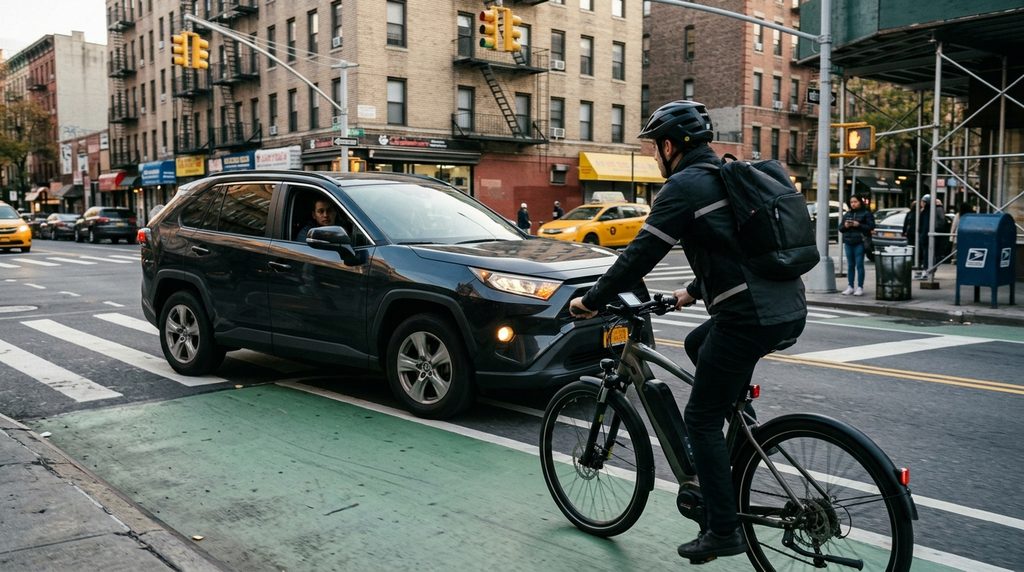
A driver may fail to yield when turning across an approaching rider’s path.
The motorist may not notice the device or may misjudge its approach speed.
Relevant evidence may include traffic signals, roadway markings, vehicle positions, and the timing of the turn.
Parked Vehicle Dooring
A driver or passenger may open a vehicle door into a bicycle lane or other travel area.
New York Vehicle and Traffic Law § 1214 generally prohibits opening a motor vehicle door toward moving traffic unless doing so is reasonably safe.
A rider may strike the door or swerve into other traffic while attempting to avoid it.
Roadway Surface Defects
Potholes, gravel, uneven pavement, and construction debris may cause riders to lose control.
Electric scooters can be particularly sensitive to sudden changes in pavement height because of their relatively small wheels.
A road defect claim must establish the responsible party’s legal duty and connection to the accident.
Pedestrian Conflicts
Collisions may occur when scooters are operated through pedestrian areas or when riders fail to yield.
The investigation may involve the rider’s speed, direction, compliance with traffic rules, and the pedestrian’s location.
An injured pedestrian may review the circumstances with a pedestrian accident attorney to evaluate potential negligence, available insurance, and legally recoverable damages.
Equipment Malfunctions
Brake failures, unstable handlebars, tire defects, and motor control problems may contribute to a loss of control.
Preserving the device can be important when the claim involves its mechanical condition.
What Do New York Court Decisions Say About Electric Bicycle and Scooter Accidents?
Recent New York appellate decisions demonstrate that liability depends on evidence showing how the collision occurred.
Davis v. Rodriguez (2026)
In Davis v. Rodriguez, decided May 27, 2026, the plaintiff alleged that his electric bicycle collided with the defendants’ vehicle.
The parties disputed the circumstances of the accident.
The Appellate Division, Second Department affirmed the denial of the defendants’ motion for summary judgment dismissing the personal injury claim.
The decision illustrates why conflicting accounts of an electric bicycle collision may require further factual examination rather than an assumption that either party was responsible.
Rosenfeld v. BM Islam (2026)
In Rosenfeld v. BM Islam, decided June 25, 2026, the plaintiff alleged that a taxicab struck his electric scooter at a Manhattan intersection.
The plaintiff argued that he had the right of way and that the taxi driver ran a red light.
However, the video did not clearly show the collision or the traffic signal facing the taxi.
The Appellate Division, First Department found that factual questions remained about how the accident occurred and whether the parties were negligent.
The court affirmed the denial of the plaintiff’s request for summary judgment on liability.
Zhi You Zhang v. Ubaldo (2026)
In Zhi You Zhang v. Ubaldo, decided July 29, 2026, an electric scooter rider brought a personal injury action after colliding with a vehicle.
The plaintiff and defendant driver provided conflicting testimony.
The appellate court determined that the dashcam video did not conclusively establish the driver’s negligence or resolve the disputed circumstances.
The court affirmed the denial of both sides’ summary judgment motions.
What These Decisions Demonstrate
These cases highlight three important points:
- A motor vehicle collision involving an e-bike or scooter does not automatically establish the driver’s liability.
- Video evidence must actually establish the relevant circumstances rather than merely show part of the incident.
- Conflicting testimony about vehicle movements, traffic signals, or right of way may require further fact-finding.
The New York court’s decision in Zhi You Zhang v. Ubaldo provides a recent example of how courts evaluate disputed electric scooter collisions.
What Evidence Is Important in an E-Bike or Scooter Accident Claim?
Evidence should help establish how the incident occurred, identify responsible parties, and document the resulting injuries.
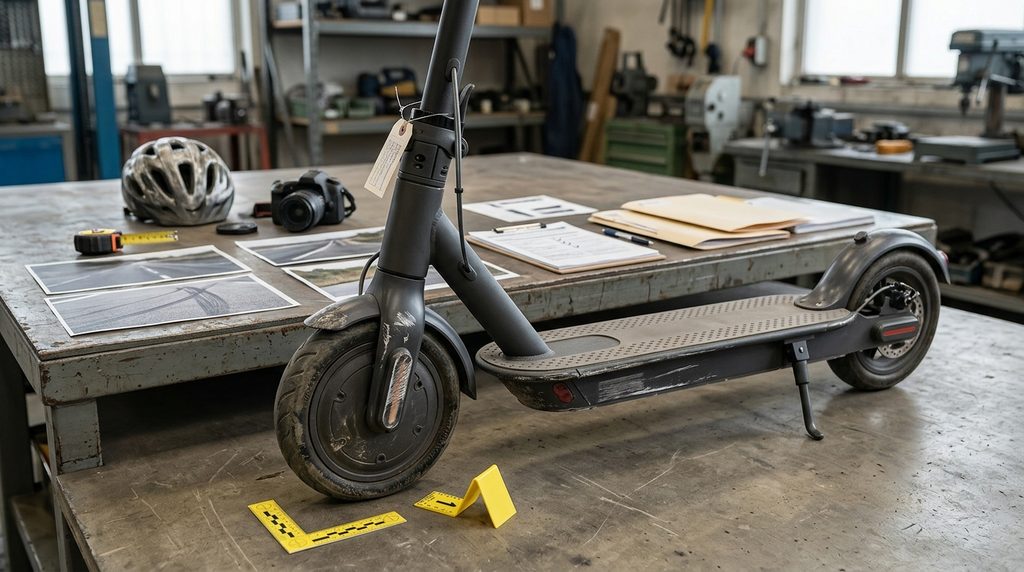
Because traffic conditions change quickly and electronic records may not be preserved indefinitely, early documentation can be particularly important.
| Evidence | Why It Matters |
| Police accident report | Records the participants and initial reported circumstances |
| Accident scene photographs | Documents road markings, hazards, and vehicle positions |
| Surveillance footage | May show the collision or relevant traffic signals |
| Dashcam recordings | May help establish vehicle movements and accident timing |
| Witness statements | Provides independent observations |
| Device specifications | Helps determine the e-bike or scooter’s legal classification |
| Rental and electronic records | May contain relevant trip or maintenance information |
| Maintenance records | May reveal prior equipment defects |
| Medical documentation | Connects injuries and treatment to the accident |
| Insurance information | Helps identify potentially applicable coverage |
Photographs of the Accident Scene
Photographs may show damaged vehicles, bicycle lanes, traffic signs, road defects, and surrounding conditions.
Images from the rider’s approach direction may help demonstrate visibility.
Surveillance and Dashcam Footage
Nearby businesses, residential security systems, traffic cameras, and private vehicles may record an accident.
Footage may help establish whether a motorist failed to yield or a rider entered an intersection against a signal.
However, as recent New York decisions demonstrate, incomplete video may not resolve every disputed fact.
Electronic and Rental Records
Some devices and rental platforms may maintain information about trips or equipment.
Potentially relevant records include:
- Device identification
- Trip start and end times
- Available location records
- Rental history
- Prior maintenance reports
- Reported mechanical problems
- Inspection and repair information
Whether these records exist or can be obtained depends on the particular device and operator.
Preserving the Device
When a claim involves equipment failure, the bicycle or scooter itself may be important evidence.
Replacing brakes, discarding a damaged wheel, or modifying the device before inspection may complicate the investigation.
Medical Records
Medical documentation should establish the injuries, treatment, and resulting limitations.
Relevant records may include emergency treatment, diagnostic imaging, specialist evaluations, surgery reports, rehabilitation notes, and work restrictions.
What Should Someone Do After an E-Bike or Scooter Accident?
Medical care and immediate safety should be the first priorities.
Once urgent needs are addressed, the following steps may help document a potential injury claim.
1. Obtain Medical Attention
Seek emergency assistance for serious injuries, including suspected head trauma, fractures, severe pain, significant bleeding, or difficulty moving.
Medical evaluation may also be important when symptoms develop after the accident.
2. Report the Accident
Contact law enforcement when appropriate and obtain any available report information.
Provide an accurate description of the incident without guessing about facts that are uncertain.
3. Identify Everyone Involved
Collect names, contact information, vehicle registrations, and insurance details when possible.
If a commercial vehicle was involved, record the company or service information.
4. Photograph the Scene
Document the vehicles, devices, road surface, traffic signals, lane markings, and visible damage.
Avoid entering active traffic to collect evidence.
5. Identify Witnesses and Cameras
Obtain witness contact information and note potential security cameras or dashcams that may have recorded the event.
6. Preserve the Electric Device
Avoid discarding or materially altering damaged components when the device’s condition may be relevant.
If the device was rented, preserve rental receipts, trip details, and available account records.
7. Keep Medical and Financial Records
Save medical bills, treatment summaries, prescription receipts, transportation expenses, and documentation of missed work.
8. Review Insurance Notice Requirements
The appropriate insurer and reporting deadline depend on the accident circumstances.
Qualifying automobile no-fault claims generally require prompt written notice.
9. Identify Applicable Lawsuit Deadlines
Claims involving motorists, private property owners, contractors, or government entities may have different procedural requirements.
Determining the responsible parties early can help avoid missed deadlines.
What Injuries Are Common in E-Bike and Scooter Accidents?
Riders have limited physical protection during collisions or falls.
The severity of an injury depends on speed, impact direction, protective equipment, and the surrounding environment.
Traumatic Brain Injuries
An e-bike or scooter rider may suffer a concussion or more serious head injury after striking a vehicle or pavement.
Symptoms may include headaches, dizziness, memory difficulties, and cognitive changes.
Wrist and Arm Fractures
Riders often extend their arms while falling.
This response can cause fractures involving the wrists, elbows, or forearms.
Shoulder Injuries
Direct impact may cause collarbone fractures, shoulder dislocations, or ligament injuries.
Some injuries require surgery or extended physical therapy.
Leg and Ankle Injuries
Electric scooter accidents may involve twisting injuries or direct impact to the lower body.
Fractures and ligament damage may limit walking and employment activities.
Back and Spinal Injuries
Serious crashes may cause spinal fractures, disc injuries, or nerve damage.
Severe cases may result in long-term functional limitations.
Facial and Dental Injuries
A rider falling forward may strike their face against the pavement, vehicle, or handlebars.
These incidents may require dental treatment, reconstructive procedures, or additional medical care.
Does No-Fault Insurance Cover E-Bike and Scooter Accidents?
Insurance coverage is one of the most important legal questions in these cases.
New York’s automobile no-fault system generally provides qualifying benefits for injuries arising from the use or operation of covered motor vehicles.
However, e-bikes, electric scooters, mopeds, and motorcycles are not necessarily treated the same.
When an Automobile Hits an E-Bike Rider
An injured electric bicycle rider may qualify for automobile no-fault benefits when a covered motor vehicle is involved and the other eligibility requirements are satisfied.
The applicable insurer is generally determined under New York’s priority-of-coverage rules.
No-fault benefits may be available regardless of which participant caused the collision, subject to statutory restrictions and exclusions.
When an Automobile Hits a Scooter Rider
A person operating a qualifying electric scooter may also have potential no-fault rights in an accident involving a covered motor vehicle.
However, the legal classification of the scooter and the particular circumstances should be examined.
An unusually powerful device classified as a moped or motorcycle may involve different insurance rules.
What Benefits May Be Available?
For qualifying claims, New York’s basic automobile no-fault coverage generally provides up to $50,000 in specified economic benefits.
These may include:
- Reasonable and necessary medical expenses
- Qualifying rehabilitation costs
- A portion of lost earnings, subject to statutory limits
- Certain necessary transportation and household assistance expenses
No-fault benefits do not ordinarily compensate a person for pain and suffering.
What Is the No-Fault Notice Deadline?
The New York Department of Financial Services states that written no-fault notice generally must be submitted within 30 calendar days of the accident.
A justification for late filing may be accepted when the applicable requirements are satisfied.
The Department of Financial Services’ insurance claim guidance explains the notice process.
What If No Automobile Was Involved?
An e-bike or scooter accident involving only a pothole, pedestrian, or another similar device does not automatically create automobile no-fault coverage.
Other potential sources of payment may include health insurance, applicable liability coverage, or a negligence claim against a responsible party.
The availability of coverage depends on the relevant policies and accident circumstances.
Can Comparative Negligence Affect an E-Bike or Scooter Claim?
Yes.
New York evaluates whether an injured person’s own conduct contributed to an accident.
For example, a driver may fail to yield while a scooter rider also travels at an unlawful speed.
The evidence must establish whether either party’s conduct caused or contributed to the collision.
How Does the General Comparative Fault Rule Work?
Under CPLR § 1411(a), an injured person’s negligence generally reduces recoverable damages according to that person’s share of responsibility.
For example:
| Factor | Illustrative Amount |
| Total legally established damages | $100,000 |
| Claimant’s fault | 20% |
| Reduction for comparative negligence | $20,000 |
| Remaining damages | $80,000 |
This example is illustrative only. It is not a settlement prediction.
What Changed in New York in 2026?
New York amended CPLR § 1411 and Insurance Law Article 51, effective May 26, 2026, for actions and proceedings commenced on or after that date.
The revised CPLR § 1411(b) generally bars recovery in covered Article 51 personal injury actions when the claimant’s culpable conduct exceeds the combined culpable conduct of the defendants.
This differs from the ordinary proportional comparative negligence rule.
The reforms also changed the definition of serious injury for covered claims, removing the former 90/180-day category.
Whether Article 51 governs a particular e-bike or scooter claim requires evaluation of the device, accident, parties, and applicable legal framework.
Does a Traffic Violation Automatically Defeat a Claim?
No.
Some provisions of New York’s e-bike and scooter statutes expressly prevent specified violations from being used to establish contributory negligence or reduce damages.
Other violations may be relevant when causally connected to an accident.
The applicable statutory language and circumstances must be evaluated rather than assuming that any violation eliminates compensation.
What Compensation May Be Available After an E-Bike or Scooter Accident?
Potential recovery depends on the nature of the injuries, available insurance, negligence, and supporting evidence.
Medical Expenses
Recoverable costs may include emergency care, hospitalization, surgery, diagnostic imaging, medication, rehabilitation, and future necessary treatment.
Lost Income
An injured person may be unable to work during recovery.
Documented missed wages and other qualifying earnings losses may be recoverable.
Reduced Earning Capacity
Permanent injuries may affect the person’s ability to work or maintain previous earnings.
Future income losses must be supported by appropriate evidence.
Pain and Suffering
A legally qualifying personal injury claim may include compensation for physical pain, emotional distress, and loss of enjoyment of life.
However, claims governed by New York’s automobile no-fault framework may be subject to the statutory serious injury requirements for recovery of non-economic damages.
Property Damage
The accident may damage an electric bicycle, scooter, helmet, phone, clothing, or other belongings.
Purchase records, photographs, and repair estimates may help establish these losses.
Long-Term Medical and Personal Care
Serious injuries may result in continuing therapy, mobility limitations, or future care requirements.
These losses may be relevant when legally recoverable and supported by medical evidence.
How Long Does Someone Have to File an E-Bike or Scooter Accident Claim?
Under CPLR § 214(5), many ordinary negligence-based personal injury lawsuits in New York must be commenced within three years.
However, shorter deadlines may apply to insurance notices and government-related claims.
| Claim or Requirement | General Deadline Consideration |
| Ordinary negligence-based personal injury lawsuit | Generally three years |
| Qualifying automobile no-fault notice | Generally within 30 days, subject to exceptions |
| Certain municipal injury claims | Notice of claim may be required within 90 days |
| Covered municipal negligence lawsuit | Generally one year and 90 days |
| Claims against New York State | Separate Court of Claims procedures may apply |
| Insurance policy claims | Applicable notice requirements depend on the policy and law |
Why Do Government-Related Claims Have Different Deadlines?
An accident caused by an unsafe public roadway or a government vehicle may involve a public entity.
Certain claims require formal notice within a much shorter period than the ordinary three-year lawsuit deadline.
The correct requirements depend on the responsible entity and the nature of the claim.
Why Should Evidence Be Preserved Early?
Bicycle and scooter components may be repaired or replaced.
Rental records and video footage may also become unavailable.
Preserving physical and electronic evidence promptly can help establish how the accident occurred.
What Mistakes Can Weaken an E-Bike or Scooter Accident Claim?
Several mistakes can make it harder to establish liability or damages.
Common problems include:
- Failing to identify the device’s correct legal classification
- Not documenting the accident scene
- Overlooking nearby surveillance cameras
- Discarding damaged equipment
- Failing to preserve rental trip records
- Delaying medical evaluation despite symptoms
- Providing speculative statements about speed or right of way
- Assuming an automobile driver is automatically responsible
- Assuming that no-fault insurance always applies
- Assuming that no insurance coverage is available
- Overlooking local e-bike and scooter restrictions
- Accepting an early settlement before understanding long-term injuries
- Missing insurance notice or lawsuit filing deadlines
A well-supported claim depends on accurate accident evidence, medical documentation, and the applicable legal and insurance rules.
When May Legal Guidance Be Useful?
Legal guidance may be particularly valuable when an e-bike or scooter accident causes serious injuries, disputed fault, uncertain insurance coverage, or substantial financial losses.

Additional investigation may be needed when an automobile is involved, the device exceeds legal motor or speed limits, a rental scooter malfunctions, or a pedestrian is injured.
A claim may require analysis of Vehicle and Traffic Law provisions, available insurance policies, surveillance footage, rental records, device specifications, and medical documentation.
People researching local legal services may review a Farmingdale personal injury office when seeking information about electric bicycle and scooter accident claims on Long Island.
Every case depends on its particular circumstances, and the involvement of an electric device does not guarantee compensation.
Frequently Asked Questions About E-Bike and Scooter Accident Claims
Can an e-bike rider sue a driver after an accident in New York?
Yes. An e-bike rider may pursue compensation when a driver’s negligence causes an accident and resulting injuries. Evidence may include traffic footage, police reports, witness statements, vehicle damage, and medical records. Depending on the circumstances, New York’s automobile no-fault insurance and serious injury rules may also apply.
Are electric scooters legal on New York roads?
Qualifying electric scooters are generally permitted on roads with posted speed limits of 30 mph or less and in designated bicycle lanes, subject to applicable local restrictions. State law limits scooter operation to 15 mph and generally prohibits riding on sidewalks unless expressly authorized locally. Operators must be at least 16 years old.
Does car insurance cover someone injured while riding an electric scooter?
Potentially. An electric scooter rider injured in a collision involving a covered automobile may qualify for certain insurance benefits, depending on the device’s legal classification and accident circumstances. A qualifying no-fault claim generally requires timely notice. Scooter-only accidents do not automatically qualify for automobile no-fault benefits.
Who is responsible if a scooter accident is caused by a pothole?
Responsibility depends on who controlled the road and whether that party breached an applicable maintenance duty. A government entity, private property owner, contractor, or utility provider may potentially be involved. Government claims can require special notice, and some roadway defect cases involve prior written notice rules.
How long does someone have to file an e-bike or scooter injury lawsuit in New York?
Many ordinary negligence-based personal injury lawsuits must be filed within three years under New York law. However, qualifying automobile no-fault claims generally require written notice within 30 days, and some government-related claims have shorter deadlines. The responsible parties, available insurance, and applicable procedures should be identified promptly.
Conclusion
E-bike and scooter accident claims in New York require careful investigation because the legal treatment of electric bicycles, electric scooters, mopeds, and motorcycles can differ significantly. Device classification may affect operating rules, insurance eligibility, and the evaluation of responsibility.
Negligent drivers, unsafe roadway conditions, careless riders, and defective equipment may each contribute to accidents, but liability must be supported by evidence. Photographs, surveillance footage, witness statements, device records, medical documentation, and insurance information can all help establish what happened.
New York’s 2026 motor vehicle insurance reforms introduce additional considerations for certain qualifying injury claims, making it important to identify the applicable legal framework.
Understanding traffic rules, potential liability, insurance coverage, available compensation, and filing deadlines can help injured riders and pedestrians evaluate potential claims using reliable evidence rather than assumptions.