


Returning to work after a car accident is not always as simple as getting back behind a desk, returning to a job site, or completing a normal shift.
Even when a vehicle damage claim is handled and the immediate stress of the accident passes, your body may still be recovering.
Some people return to work and notice:
- Neck stiffness while looking at a computer
- Back pain after sitting for long periods
- Shoulder discomfort while reaching or lifting
- Headaches during the workday
- Trouble concentrating because of discomfort
- Fatigue after normal tasks
- Pain while commuting
- Difficulty completing physical job duties
Recovery is not only about whether you can show up for work.
It is also about whether your body can safely handle the movements, positions, and demands required by your job.
For patients who need injury doctors after an accident in Forest Hill, Premier Injury Clinics of DFW provides accident-focused chiropractic care, rehabilitation therapy, injury evaluations, structured recovery plans, and transportation assistance for qualifying patients.
Quick Answer
Returning to work after a car accident depends on the type of injury, job requirements, symptoms, mobility, and recovery progress.
Before returning fully, consider:
- Can you sit, stand, walk, or lift comfortably?
- Can you drive safely?
- Can you complete your normal job movements?
- Does pain increase during or after activity?
- Are headaches, stiffness, numbness, or tingling improving?
- Can you sleep well enough to recover between shifts?
- Has your movement improved since the accident?
An accident-focused evaluation may help determine how injuries affect your ability to return to normal activities.
Emergency care should come first for serious symptoms such as loss of consciousness, chest pain, trouble breathing, severe headache, confusion, repeated vomiting, weakness, slurred speech, severe neck or back pain after trauma, or loss of bladder or bowel control.
Key Takeaways
- Returning to work after a car accident should be based on recovery progress, not only time passed.
- Different jobs create different physical demands.
- Sitting jobs may aggravate neck and back symptoms.
- Physical jobs may require careful evaluation of lifting, bending, reaching, and endurance.
- Driving discomfort can affect both commuting and job responsibilities.
- Rehabilitation therapy may support mobility, strength, flexibility, and daily function.
- Tracking symptoms can help explain recovery progress during an evaluation.
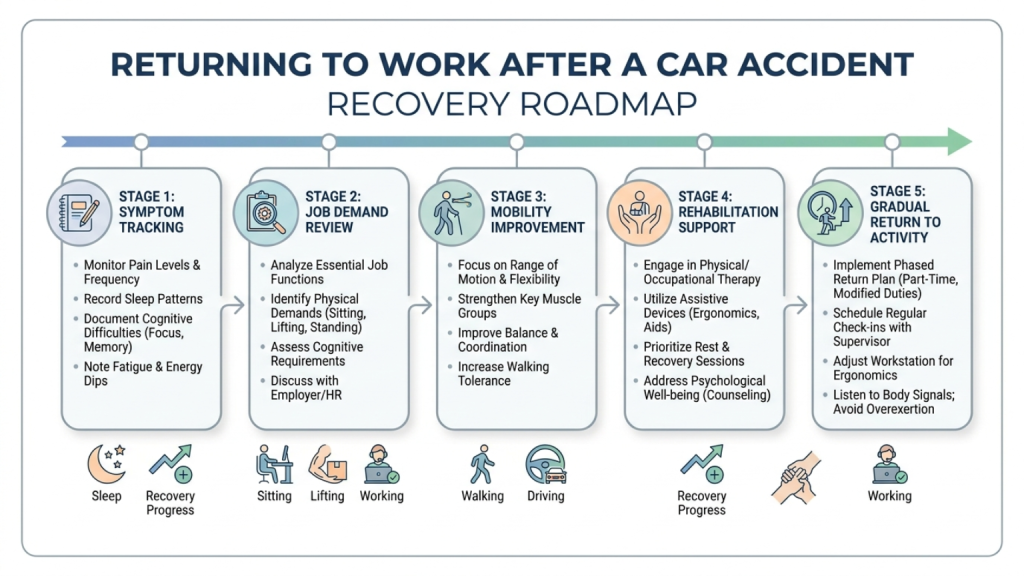
The Return-To-Work Readiness Roadmap
Every job places different demands on the body.
A person working at a computer may struggle with neck pain and headaches.
A warehouse employee may struggle with lifting and standing.
A delivery driver may struggle with sitting, steering, entering vehicles, and repeated driving.
That is why returning to work after an accident should be viewed as a process.
Stage 1: Understand Your Symptoms
Before returning, identify:
- Where does it hurt?
- When does pain appear?
- What movements trigger symptoms?
- Does activity improve or worsen symptoms?
- Are symptoms affecting sleep?
- Are symptoms changing over time?
Common accident-related symptoms include:
- Neck pain
- Back pain
- Whiplash symptoms
- Headaches
- Shoulder pain
- Soft tissue soreness
- Joint discomfort
- Stiffness
- Reduced mobility
- Numbness or tingling
Stage 2: Compare Symptoms With Job Demands
Your workplace may require:
| Job Demand | Possible Challenge After Accident |
| Sitting | Back pain, stiffness, posture discomfort |
| Standing | Leg, hip, knee, or back discomfort |
| Driving | Neck rotation, shoulder movement, sitting tolerance |
| Lifting | Back strain, shoulder pain, reduced strength |
| Reaching | Shoulder stiffness or upper-body discomfort |
| Walking | Knee pain, balance issues, reduced endurance |
| Computer work | Neck stiffness, headaches, posture fatigue |
| Physical labor | Mobility limits, strength concerns, fatigue |
The goal is not only returning to work.
The goal is returning safely.
Why Work May Feel Different After A Crash
Many accident injuries are not obvious from the outside.
A person may look healthy but still experience:
- Pain while sitting
- Limited neck movement
- Difficulty lifting
- Reduced stamina
- Headaches
- Sleep disruption
- Muscle tightness
- Stress during driving
These issues can affect job performance and comfort.
For example:
A person who normally sits eight hours a day may discover that prolonged sitting increases back pain.
A person who drives for work may find that checking mirrors or turning the head is uncomfortable.
Also, a person with a physically demanding job may notice difficulty lifting, bending, or carrying.
Understanding these limitations is an important part of recovery.
Neck Pain, Headaches, And Desk Work
Office workers often underestimate how much the neck and upper body contribute to daily tasks.
After a car accident, neck symptoms may affect:
- Looking at a computer screen
- Sitting upright
- Turning the head
- Talking on the phone
- Driving to work
- Concentrating during meetings
Whiplash symptoms may include:
- Neck pain
- Neck stiffness
- Headaches
- Shoulder discomfort
- Reduced range of motion
- Tingling
- Fatigue
Mayo Clinic explains that whiplash may occur when the neck moves forcefully and rapidly back and forth.
For office workers, recovery may involve evaluating:
- Sitting tolerance
- Posture comfort
- Screen positioning
- Break frequency
- Neck mobility
- Headache patterns
Physical Jobs After A Car Accident
Returning to a physically demanding job may require additional planning.
Physical jobs may involve:
- Heavy lifting
- Carrying
- Bending
- Reaching
- Standing for long periods
- Climbing
- Repetitive movement
Accident injuries may make these activities more difficult.
Common concerns include:
- Back pain during lifting
- Shoulder pain during reaching
- Knee discomfort during standing
- Reduced endurance
- Muscle tightness
- Increased soreness after work
A gradual return may help patients understand what activities their bodies can tolerate.
Driving Back To Work After An Accident
For many workers, returning to work begins with returning to driving.
Driving may be challenging because of:
- Neck stiffness
- Difficulty checking blind spots
- Shoulder pain while steering
- Back pain from sitting
- Hip discomfort
- Anxiety after the crash
Before returning to regular driving, consider:
- Can you comfortably turn your head?
- Can you sit for your commute?
- Can you react quickly?
- Does driving increase symptoms?
- Are you comfortable behind the wheel?
If driving feels different after an accident, mention it during an evaluation.
Sleep And Recovery Before Returning To Work
Sleep is an important part of recovery.
Pain can affect sleep through:
- Difficulty finding a comfortable position
- Waking because of stiffness
- Neck discomfort
- Back pain
- Headaches
- Muscle tightness
Poor sleep can also affect:
- Concentration
- Energy
- Patience
- Physical endurance
- Work performance
Tracking sleep changes can help explain how injuries affect daily life.
When Injury Doctors May Help Evaluate Recovery
After an accident, many people wonder:
“Am I ready to return to normal?”
An evaluation may help answer questions about:
- Mobility
- Pain patterns
- Range of motion
- Functional limitations
- Work-related movements
- Recovery progress
An accident-focused evaluation may include:
- Accident history review
- Symptom discussion
- Movement assessment
- Range-of-motion evaluation
- Functional activity review
- Recovery planning
The goal is to understand how the injury affects your ability to move and function.
Rehabilitation Therapy And Returning To Activity
Returning to work is often about rebuilding function.
Rehabilitation therapy may support:
- Mobility
- Strength
- Flexibility
- Stability
- Movement control
- Endurance
- Confidence with activity
A recovery plan may include:
- Guided exercises
- Stretching
- Strengthening
- Mobility work
- Functional movement training
- Progress monitoring
The goal is not simply reducing discomfort.
The goal is helping the body handle normal activities again.
Forest Hill Recovery Support
Local care can make follow-up easier because recovery may require multiple visits.
Premier Injury Clinics of DFW’s Forest Hill location is:
3501 Forest Hill Cir
Forest Hill, TX 76140
The clinic serves patients from:
- Forest Hill
- Fort Worth
- Everman
- Kennedale
- Edgecliff Village
- Burleson
- Surrounding Tarrant County communities
Nearby areas include:
- I-20
- I-35W
- Loop 820
- Mansfield Highway
- Forest Hill Drive
- South Fort Worth
Transportation assistance may be available for qualifying patients recovering after an accident.
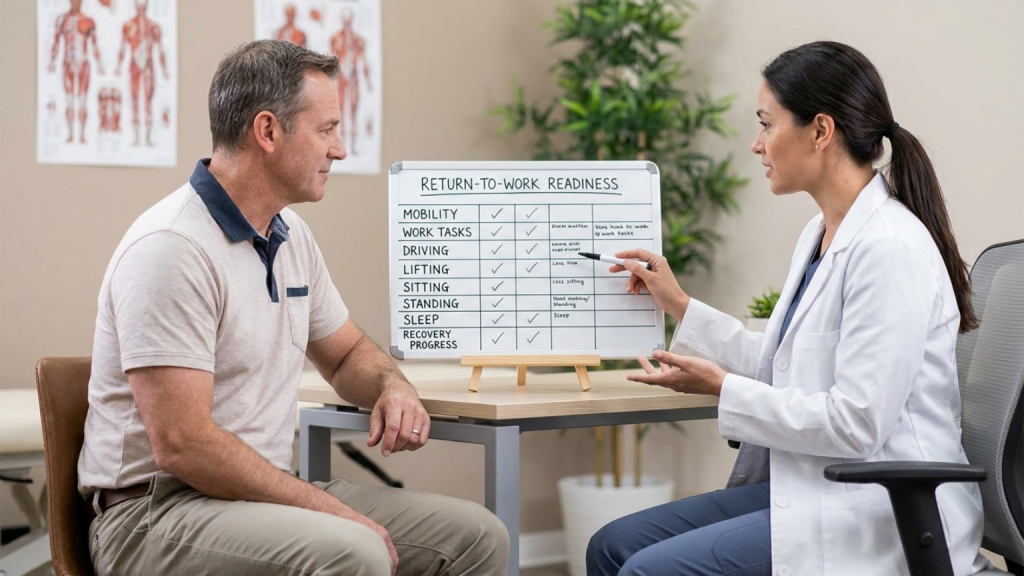
Return-To-Work Checklist After A Car Accident
Before returning fully, consider these questions:
| Question | Why It Matters |
| Can I complete my normal job movements? | Shows whether work demands match current ability |
| Can I drive comfortably? | Important for commuting and driving jobs |
| Can I sit or stand for required periods? | Helps evaluate endurance |
| Can I lift safely? | Important for physical work |
| Is pain improving? | Shows recovery progress |
| Am I sleeping well? | Supports energy and healing |
| Are headaches improving? | Helps monitor symptoms |
| Are numbness or tingling present? | Should be discussed during evaluation |
| Are symptoms worse after activity? | Helps adjust recovery planning |
Mistakes To Avoid When Returning To Work
Returning Too Quickly
Feeling better for one day does not always mean the body is ready for full activity.
Ignoring Pain During Work
Pain during work may be a sign that activity levels need adjustment.
Forgetting About Driving
A commute can reveal neck, back, shoulder, and hip limitations.
Only Tracking Pain
Movement and function matter too.
Skipping Recovery Exercises
Rehabilitation activities may support strength, flexibility, and mobility.
Emergency Warning Signs
Seek emergency medical care immediately for:
- Loss of consciousness
- Chest pain
- Trouble breathing
- Severe or worsening headache
- Confusion
- Repeated vomiting
- Weakness on one side of the body
- Slurred speech
- Heavy bleeding
- Severe abdominal pain
- Severe neck or back pain after trauma
- Numbness or weakness in arms or legs
- Loss of bladder or bowel control
- Seizure
- Unequal pupils
- Unusual behavior after head trauma
The CDC lists danger signs after possible traumatic brain injury or concussion, including worsening headache, repeated vomiting, weakness, numbness, seizures, slurred speech, confusion, unusual behavior, unequal pupils, and loss of consciousness.
Frequently Asked Questions
Return timing depends on injury type, symptoms, job demands, mobility, and recovery progress. Some people return quickly while others need more time and modified activity.
Common challenges include neck pain, back pain, whiplash symptoms, headaches, stiffness, soft tissue soreness, joint pain, numbness, tingling, and reduced mobility.
Yes. Explain whether your job requires sitting, standing, lifting, driving, walking, reaching, or repetitive movements.
Rehabilitation therapy may support mobility, strength, flexibility, stability, and functional movement needed for daily activities.
Neck stiffness, back pain, shoulder discomfort, and reduced mobility can make turning, steering, sitting, and checking surroundings harder.
Track pain, mobility, sleep, driving comfort, work tasks, lifting ability, headaches, numbness, tingling, and symptom changes after activity.
Premier Injury Clinics of DFW serves Forest Hill, Fort Worth, Everman, Kennedale, Edgecliff Village, Burleson, and surrounding Tarrant County communities.
Final Thoughts
Returning to work after a car accident is not only about time. It is about whether your body can safely handle the movements, positions, and responsibilities your job requires.
Neck pain, back pain, headaches, stiffness, soft tissue soreness, joint pain, numbness, tingling, and reduced mobility can all affect work performance and daily comfort.
Tracking symptoms, understanding job demands, and discussing recovery progress with healthcare providers can help create a safer path back to normal activity.
Premier Injury Clinics of DFW’s Forest Hill location provides accident-focused chiropractic care, rehabilitation therapy, structured recovery plans, progress monitoring, and transportation assistance for qualifying patients.
Visit the Premier Injury Clinics of DFW Forest Hill location page to learn more about accident injury evaluations, chiropractic care, rehabilitation therapy, and recovery support after an auto accident.