


The right fit can make a major difference in how medical scrubs feel and perform throughout a healthcare workday. A uniform needs to accommodate walking, reaching, bending, sitting, standing, and other repeated movements without becoming restrictive or excessively loose.
Fit also affects how a uniform looks. A scrub top that pulls across the shoulders or a pair of pants that bunch around the ankles can make an otherwise well-designed uniform look less polished. On the other hand, clothing that is excessively loose can interfere with movement and create unnecessary bulk.
For that reason, choosing comfortable medical scrubs is not simply a matter of selecting a preferred size. The best fit combines body measurements, garment cut, fabric stretch, proportions, and the physical demands of the job.
Quick Answer
Well-fitting scrubs should provide enough room for normal movement while maintaining a comfortable, controlled silhouette. The correct fit should not feel restrictive when reaching, bending, sitting, or walking, but it should also avoid excessive fabric that can interfere with movement or appearance.
When evaluating scrub fit, focus on:
- Shoulder fit: The shoulder seam should sit appropriately without excessive pulling or dropping.
- Chest and torso room: The garment should allow normal movement without excessive tension.
- Waistband comfort: Pants should stay in place without creating uncomfortable pressure.
- Hip and thigh room: Pants need sufficient space for walking, sitting, bending, and squatting.
- Inseam: Pant length should correspond to the wearer’s proportions and preferred fit.
- Sleeve length: Sleeves should allow movement without becoming restrictive.
- Fabric stretch: Stretch can provide additional mobility when appropriately balanced with recovery.
- Garment cut: Joggers, tapered pants, straight-leg pants, and relaxed styles can fit very differently.
- Work requirements: The ideal fit depends partly on how physically active the wearer is.
A good scrub fit should support the workday rather than require the wearer to constantly adjust the uniform.
Why Does Scrub Fit Matter?
Medical scrubs are workwear.
Unlike clothing worn for a short period, scrubs may remain on the body for eight, ten, twelve, or more hours depending on the professional’s schedule.
During that time, the wearer may repeatedly:
- Walk
- Stand
- Sit
- Reach
- Bend
- Stretch
- Lift
- Squat
- Assist patients
- Move equipment
A poorly fitted garment can become increasingly uncomfortable as these movements are repeated.
Fit can influence:
- Comfort
- Range of movement
- Fabric tension
- Waistband pressure
- Pocket position
- Garment appearance
- Ease of layering
- Overall confidence
The importance of proper fit is not limited to ordinary scrubs. CDC guidance on healthcare protective clothing also identifies garment size, comfort, ergonomics, and human factors as important considerations when selecting protective clothing. It notes that incorrectly sized garments can be more vulnerable to stress during movements such as kneeling, reaching, or bending.
What Does a Well-Fitting Scrub Uniform Look Like?
A well-fitting scrub uniform should look balanced without appearing excessively tight or oversized.
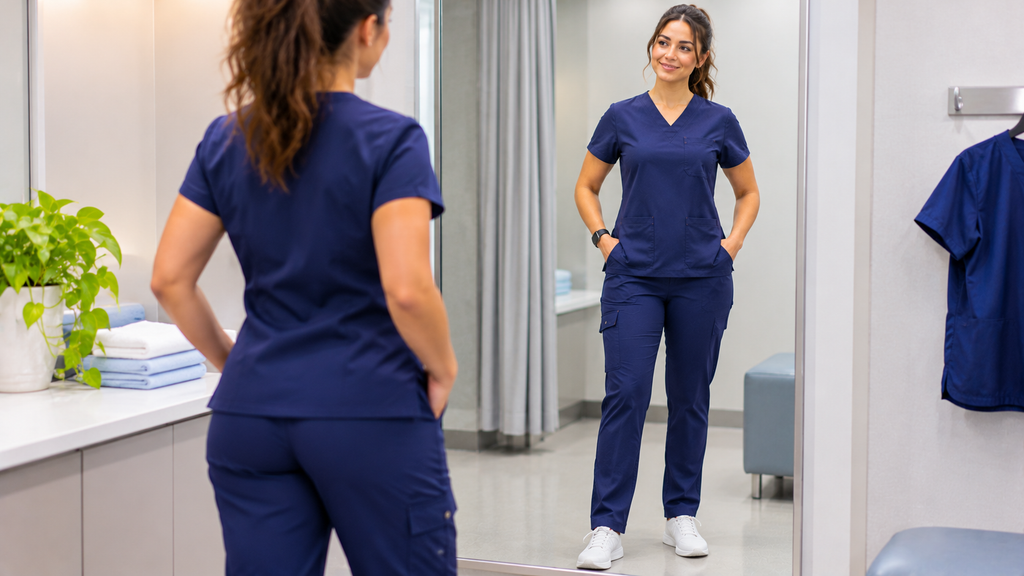
The exact appearance varies by garment style, but several general signs can help.
A well-fitting top typically:
- Sits comfortably across the shoulders
- Allows the arms to move freely
- Does not pull excessively across the chest
- Provides appropriate torso coverage
- Does not bunch excessively around the waist
- Keeps pockets in a practical position
Well-fitting pants typically:
- Sit securely at the waist
- Provide adequate room through the hips and thighs
- Allow normal knee movement
- Maintain an appropriate rise
- Have a suitable inseam
- Do not excessively bunch at the ankle
The goal is controlled ease: enough room for movement without unnecessary excess fabric.
How Should Scrub Tops Fit?
Scrub tops should allow unrestricted upper-body movement while maintaining an appropriate silhouette.
Start with the shoulders.
The shoulder seam should generally align with the natural shoulder area rather than sitting far down the arm or pulling toward the neck.
Next, evaluate the chest and torso.
The fabric should not create excessive horizontal pulling when the wearer reaches forward or raises the arms.
At the same time, an excessively oversized top can create unnecessary volume and may cause pockets to sit lower than intended.
Check the Shoulders
Shoulder fit is particularly important because the shoulders are involved in many everyday healthcare movements.
Try:
- Raising both arms
- Reaching forward
- Reaching overhead
- Crossing the arms
- Rotating the upper body
The top should move with the body without creating excessive tension.
Check the Chest and Torso
Look for:
- Pulling across the chest
- Gaping around the neckline
- Excessive fabric under the arms
- Bunching around the waist
- Hem movement during reaching
A top that fits comfortably when standing may feel very different once the wearer begins moving.
How Should Scrub Pants Fit?
Scrub pants should provide sufficient room for movement while remaining secure at the waist.
Key areas include:
- Waist
- Rise
- Hips
- Seat
- Thighs
- Knees
- Calves
- Inseam
- Ankle opening
The correct fit depends on the style.
A jogger is intentionally narrower toward the ankle than a straight-leg pant. A wide-leg style has more volume through the lower leg. A tapered pant falls between more traditional and fitted silhouettes.
The size should therefore be evaluated together with the garment’s cut.
Why Is the Waistband So Important?
The waistband is one of the areas that can determine whether scrub pants remain comfortable throughout a long shift.
A waistband that is too tight can create pressure when sitting or bending.
One that is too loose may require constant adjustment.
Different waistband constructions include:
- Elastic waistbands
- Drawstring waistbands
- Half-elastic waistbands
- Yoga-style waistbands
- Combination constructions
Each can provide a different wearing experience.
The best option depends on body proportions, movement, fabric stretch, and personal preference.
How Much Room Should Scrub Pants Have in the Hips and Thighs?
Enough to allow normal movement without excessive fabric.
The hips and thighs are particularly important because these areas move significantly when walking, sitting, bending, and squatting.
Signs that pants may be too tight include:
- Pulling across the hips
- Tightness around the thighs
- Restricted movement
- Pocket openings pulling outward
- Excessive fabric tension when sitting
Signs that they may be too loose include:
- Excess fabric
- Constant waistband adjustment
- Excessive bunching
- Pockets sitting away from the body
A different cut can sometimes solve these problems more effectively than simply changing size.
How Important Is Inseam Length?
Inseam length is an important part of scrub-pant fit.
Two people can have the same waist measurement but require different inseams.
An overly short pant may expose too much ankle or change the intended silhouette.
An overly long pant may bunch around the shoe or ankle.
When choosing pants, consider:
- Body proportions
- Height
- Actual inseam
- Shoe type
- Desired silhouette
- Available short, regular, or tall lengths
Height is useful as a general reference, but inseam can provide more specific information about leg length.
How Does Scrub Fit Affect Mobility?
Fit and mobility are closely connected.

A garment that is too tight can restrict movement.
A garment that is excessively loose can also interfere with movement because excess material may catch, bunch, or shift.
The ideal fit provides sufficient ease in areas that move frequently.
For example:
- Shoulders need room for reaching.
- Elbows need room for bending.
- Hips need room for walking.
- Knees need room for squatting.
- Waistbands need flexibility when sitting.
The CDC similarly emphasizes garment size, comfort, ergonomics, and the physical activities performed by healthcare workers when considering protective clothing.
How Does Fabric Stretch Affect Fit?
Stretch can provide additional flexibility, but it does not eliminate the need for correct sizing.
A fabric containing elastane or spandex may accommodate movement more easily than a rigid fabric.
Stretch can be particularly useful for:
- Reaching
- Bending
- Sitting
- Squatting
- Walking
- Lifting
However, excessive reliance on stretch can also create problems.
If a garment is consistently stretched to accommodate the body, the fabric may experience unnecessary tension.
The better approach is to select a garment that fits correctly while using stretch as an additional mobility feature.
Is More Stretch Always Better?
No.
A garment with maximum stretch is not necessarily the most comfortable.
A good workwear fabric needs a balance of:
- Flexibility
- Recovery
- Structure
- Durability
- Comfort
A highly elastic fabric can still feel poorly fitted if the garment is too small or the cut does not suit the wearer’s proportions.
Stretch should support a good fit, not compensate for a bad one.
How Does Scrub Cut Affect Fit?
The same nominal size can feel very different depending on the cut.
Common scrub silhouettes include:
- Relaxed
- Classic
- Tailored
- Tapered
- Athletic
- Jogger
- Wide-leg
A tailored top may sit closer to the body than a relaxed top.
A jogger may feel more fitted through the lower leg than a straight-leg pant.
A wide-leg pant can provide more room through the calf and ankle without requiring a larger waist size.
This is why size and cut should always be considered together.
How Does Fit Affect Professional Appearance?
Professional appearance is influenced by proportion.
A uniform can look less polished when:
- The shoulders are too wide
- The top is excessively long
- The pants bunch heavily
- The waistband folds
- The garment pulls across the body
- Sleeves are substantially too long
- The fabric is excessively loose
A properly fitted garment generally creates a cleaner visual line.
This does not mean scrubs need to be tight.
Professional appearance comes from appropriate proportions and a controlled silhouette, not from wearing the smallest possible size.
Can Loose Scrubs Still Look Professional?
Absolutely.
A relaxed fit can be professional when it is intentionally designed that way.
The key distinction is between relaxed and oversized.
A relaxed garment provides additional ease while maintaining appropriate proportions.
An oversized garment may have excessive shoulder width, torso length, sleeve length, or fabric volume.
The right choice depends on the garment design and the workplace environment.
Can Fitted Scrubs Be Professional?
Yes.
A fitted scrub can look polished when it provides sufficient room for movement and maintains appropriate coverage.
The problem occurs when a garment is so fitted that it creates constant tension or restricts normal movement.
Healthcare workwear should support function first while maintaining a professional appearance.
How Should Women Evaluate Scrub Fit?
Women’s scrub garments can vary substantially in silhouette.
Important measurements and fit areas include:
- Bust
- Shoulders
- Waist
- Hips
- Thighs
- Inseam
- Torso length
Different body proportions can make some silhouettes more comfortable than others.
For example, someone with broader shoulders may need additional upper-body room even if their waist corresponds to a smaller size.
A practical approach is to evaluate women’s medical scrubs according to both measurements and garment cut rather than relying on a size number alone.
How Should Men Evaluate Scrub Fit?
Men’s scrub fit also depends on body proportions and garment construction.
Important areas include:
- Chest
- Shoulders
- Waist
- Seat
- Thighs
- Inseam
A professional with broader shoulders may require a different top size than their pant size.
Similarly, athletic or tapered pant cuts may fit differently through the thigh and lower leg than relaxed styles.
When choosing men’s medical scrubs, evaluate the individual garment rather than assuming that all styles in the same size will fit identically.
How Should Nurses Choose Scrub Fit?
Nursing can involve substantial walking, standing, bending, reaching, and patient-care activities.
For this type of work, useful fit characteristics may include:
- Comfortable shoulder movement
- Adequate hip and thigh room
- Flexible waistbands
- Appropriate inseam
- Useful stretch
- Secure but comfortable fit
A nurse may spend much of the shift moving between different positions, making mobility particularly important.
The uniform should remain comfortable whether the wearer is standing at a workstation, walking down a corridor, or assisting a patient.
How Should Physicians Choose Scrub Fit?
Physicians can have very different work patterns depending on their specialty and clinical environment.
Someone working primarily in examination rooms may have different mobility requirements from someone performing procedures or spending substantial time on their feet.
A physician’s scrub fit should therefore reflect:
- Work activity
- Desired appearance
- Fabric characteristics
- Mobility
- Layering requirements
The best fit is the one that supports the actual work environment.
How Should Medical Students Choose Scrub Fit?
Medical students often move through different clinical environments during training.
A versatile fit can therefore be useful.
Consider:
- Comfortable movement
- Appropriate coverage
- Professional appearance
- Practical fabric
- Easy care
- Workplace requirements
Students should also confirm any institution-specific requirements before purchasing multiple uniforms.
How Does Fit Affect Long Shifts?
Small fit problems become more noticeable over time.
A waistband that feels slightly tight after one hour may become uncomfortable after ten hours.
A shoulder seam that pulls during occasional reaching can become distracting when the same movement is repeated throughout a shift.
For long shifts, pay particular attention to:
- Waistband comfort
- Shoulder mobility
- Inseam
- Fabric stretch
- Breathability
- Overall garment weight
The best long-shift fit is one that remains comfortable rather than merely acceptable when first put on.
How Can You Test Scrub Fit Before Buying Several Sets?
Start with one garment whenever possible.
Wear it through realistic movements.
For Tops
Try:
- Raising both arms
- Reaching forward
- Sitting
- Bending
- Rotating the torso
For Pants
Try:
- Walking
- Sitting
- Bending
- Squatting
- Climbing stairs
- Checking the waistband
If the garment remains comfortable during these activities, it provides better evidence of suitability than simply looking in a mirror.
What Are Signs That Scrubs Are Too Tight?
For tops:
- Pulling across the chest
- Restricted shoulders
- Tight upper arms
- Hem riding upward
- Side seams pulling
- Difficulty raising the arms
For pants:
- Waistband pressure
- Pulling across hips
- Tight thighs
- Restricted knees
- Pockets pulling outward
- Excessive tension while sitting
If several of these signs appear, consider a different size or cut.
What Are Signs That Scrubs Are Too Loose?
For tops:
- Dropped shoulders
- Excess fabric around the torso
- Sleeves extending too far
- Excessive hem length
- Pockets sitting unusually low
For pants:
- Waistband slipping
- Excess fabric around the hips
- Excessive bunching
- Pockets pulling away from the body
- Excess fabric around the ankles
Sizing down may solve some problems, but not all.
Sometimes a different garment cut is the better solution.
What If Your Top and Bottoms Are Different Sizes?
That is completely normal.
Body proportions do not always correspond to a single standardized clothing size.
Someone may need:
- A larger top for shoulder room
- A smaller pant waist
- A longer inseam
- More hip room
- A different cut for the pants
When buying separate pieces, prioritize the correct fit of each garment rather than forcing both pieces into the same size.
How Should You Choose Comfortable Medical Scrubs?
Start with the workday rather than the appearance of the garment alone.
Ask:
- How much do I walk?
- How often do I bend?
- Do I sit for long periods?
- Do I need to reach frequently?
- Is the workplace warm or cool?
- Do I layer?
- How often will the garment be washed?
Then evaluate the garment’s:
- Fit
- Fabric
- Stretch
- Weight
- Cut
- Waistband
- Inseam
- Pocket placement
A comfortable scrub is one that continues to feel appropriate after hours of actual work.
Does Scrub Fit Affect Pocket Placement?
Yes.
The position of a pocket can change when a garment is too large or too small.
A top that is oversized may place pockets lower than intended.
A tight top may cause pockets to pull or gape.
Similarly, oversized pants can cause pockets to sit farther away from the body, while tight pants can make pocket openings pull outward.
Pocket function should therefore be evaluated together with fit.
How Does Fit Affect Scrub Layering?
Layering works best when the base garment provides enough room for normal movement without already being excessively loose.
A scrub jacket worn over a very fitted top may feel restrictive.
A jacket worn over an oversized top may create excessive bulk.
The base uniform and outer layer should therefore be considered as a combination.
Can the Wrong Fit Reduce Garment Durability?
It can.
A garment that is consistently stretched beyond its intended fit may place additional stress on:
- Seams
- Fabric
- Closures
- Waistbands
- Pocket attachments
CDC guidance on protective clothing specifically notes that incorrect sizing can expose garments to stresses such as kneeling, reaching, and bending and that garments that are too large may catch or snag.
Although ordinary scrubs are not necessarily PPE, the broader principle is useful: garment size and construction should be appropriate for the movements and conditions in which the clothing is used.
How Does Body Shape Affect Scrub Fit?
Standard sizing cannot perfectly represent every body shape.
People can have different combinations of:
- Shoulder width
- Bust or chest
- Waist
- Hip width
- Thigh circumference
- Leg length
- Torso length
This is why a person can technically select the correct size according to one measurement and still find the garment uncomfortable elsewhere.
When this happens, consider the garment’s silhouette and construction rather than assuming the entire wardrobe needs a different size.
How Should You Choose Between Relaxed and Tailored Scrubs?
Consider the work and preferred appearance.
Relaxed Fit
Can provide:
- More ease
- Greater visual volume
- Easy layering
- A traditional workwear appearance
Tailored Fit
Can provide:
- More defined proportions
- A closer silhouette
- A more structured appearance
Neither is universally better.
The appropriate choice depends on comfort, mobility, workplace expectations, and personal preference.
How Should You Choose Between Jogger and Straight-Leg Scrub Pants?
The choice is primarily about silhouette and comfort.
Joggers
Typically provide:
- A tapered lower leg
- A more contemporary appearance
- Reduced fabric around the ankle
Straight-Leg Pants
Typically provide:
- A more traditional silhouette
- More consistent width through the lower leg
- Different drape around shoes
Neither style is inherently more professional.
The better option is the one that fits comfortably and works with the wearer’s movement and workplace requirements.
Does Fabric Weight Affect How Scrubs Fit?
Fabric weight does not change the numerical size, but it can change how the garment feels and drapes.
A lightweight fabric may move more freely.
A heavier fabric may provide more structure.
A soft fluid fabric may hang differently from a structured woven fabric even when both garments are the same nominal size.
Therefore, fabric should be considered alongside size and cut.
How Does Breathability Relate to Fit?
Breathability and fit are separate characteristics, but they interact.
A tight garment can feel warmer because there is less room for air movement between the fabric and body.
A very loose garment may allow more air movement but can create unnecessary fabric.
The most comfortable combination is often an appropriately fitted garment made from a fabric suited to the working environment.
What Are Common Scrub-Fit Mistakes?
Choosing Based Only on Size Number
A size label does not describe the entire garment.
Sizing Up Automatically
More fabric does not always mean more comfort.
Sizing Down for Appearance
A smaller garment can restrict movement and create visible pulling.
Ignoring Inseam
Waist size alone does not determine pant length.
Ignoring Garment Cut
A jogger and straight-leg pant can fit very differently in the same nominal size.
Testing Only While Standing
Work requires movement, so the uniform should be tested accordingly.
Ignoring Fabric Stretch
A rigid fabric and a stretch fabric may behave differently at the same size.
Buying Multiple Sets Before Testing One
A style that looks good may not remain comfortable throughout a shift.
How Should You Compare Different Scrub Fits?

| Fit Factor | What to Evaluate |
| Shoulders | Does the seam sit naturally? |
| Chest | Is there pulling or excessive space? |
| Waist | Does the garment stay secure without pressure? |
| Hips | Is there enough room for movement? |
| Thighs | Can you walk, sit, and bend comfortably? |
| Inseam | Does the pant end at the intended point? |
| Sleeves | Can the arms move freely? |
| Fabric stretch | Does the material support movement? |
| Garment cut | Is the silhouette appropriate? |
| Overall appearance | Does the uniform look balanced? |
This framework helps distinguish a genuinely good fit from a garment that simply looks appropriate while standing still.
How Can You Build a Better-Fitting Scrub Wardrobe?
Start with the garments that have already proven comfortable.
Identify:
- Preferred top size
- Preferred pant size
- Best inseam
- Preferred waistband
- Preferred fabric stretch
- Preferred pant silhouette
- Preferred top cut
Then use these characteristics as your purchasing baseline.
Instead of buying many unrelated styles, gradually build the wardrobe around proven fits.
This can make future shopping more predictable and reduce the number of garments that remain unworn.
Key Takeaways
Scrub fit affects much more than appearance. It can influence how comfortably a healthcare professional moves, sits, bends, reaches, and works throughout a shift.
The most important principles are:
- Fit should support movement: Scrubs need enough room for the activities required during work.
- Do not rely only on size labels: Measurements and garment-specific sizing information matter.
- Check shoulders carefully: Poor shoulder fit can restrict upper-body movement.
- Evaluate the waist and hips: Pants should remain secure without creating pressure.
- Choose the correct inseam: Height alone does not determine pant length.
- Consider garment cut: Joggers, tapered, straight-leg, and wide-leg styles can fit very differently.
- Use stretch appropriately: Stretch can improve mobility but should not compensate for an incorrect size.
- Test movement: Walk, sit, bend, reach, and squat when evaluating a new garment.
- Consider appearance and function together: A polished uniform should still allow normal movement.
- Do not assume one size fits every garment: Different styles can have different proportions.
- Test before buying multiples: One full workday can reveal fit issues that a fitting room cannot.
The best-fitting scrub is ultimately the one that remains comfortable and functional throughout the workday while maintaining an appropriate professional appearance.
Frequently Asked Questions
How should medical scrubs fit?
Medical scrubs should provide enough room for normal movement without excessive fabric. The shoulders, chest, waist, hips, thighs, sleeves, and inseam should all be appropriate for the wearer’s proportions and the garment’s intended silhouette.
Should scrubs be tight or loose?
Neither extreme is ideal. Scrubs should provide comfortable ease without excessive restriction or unnecessary bulk. A relaxed or tailored fit can both be appropriate depending on the garment and workplace.
How do I know if my scrub top is too small?
Look for pulling across the chest, restricted shoulders, tight upper arms, upward movement of the hem, or difficulty raising the arms. These signs may indicate that you need a larger size or a different cut.
How do I know if my scrub pants are too small?
Tightness across the waist, hips, thighs, or seat, along with restricted movement or pockets pulling outward, can indicate that the pants are too small or that the particular cut does not suit your proportions.
Should scrub pants be loose around the thighs?
They should provide enough room for walking, sitting, bending, and other normal movements without excessive fabric. The appropriate amount of room depends on the pant silhouette and the wearer’s body proportions.
Are stretch scrubs better for long shifts?
Stretch can make long shifts more comfortable by supporting movement, especially when the job involves frequent bending, reaching, walking, or sitting. However, stretch should complement correct sizing rather than compensate for an overly small garment.
Should scrub tops and pants be the same size?
Not necessarily. Body proportions often require different sizes for tops and bottoms. It is perfectly reasonable to need more room in the shoulders and chest while wearing a smaller pant size, or vice versa.
Does height determine scrub size?
Height is useful for considering garment proportions and length, but it does not determine overall size. Chest, waist, hip, and inseam measurements provide more specific information.
How can I make scrubs look more professional?
Start with correct sizing and balanced proportions. A clean garment with appropriate shoulder, torso, waist, and pant length generally looks more polished than clothing that is excessively tight or oversized.
Should I buy several scrub sets at once?
It is usually better to test a new style before buying a large quantity. Wear one garment through realistic movements and, ideally, a full workday before expanding the wardrobe.
Conclusion
Scrub fit is one of the most important factors in determining whether a healthcare uniform works well in practice. A garment may have an attractive fabric, useful pockets, and a professional design, but if the fit restricts movement or creates excessive bulk, those features become less valuable.
The ideal fit provides enough room for the movements required during the workday while maintaining a controlled and professional silhouette. Shoulders should allow reaching, tops should provide appropriate chest and torso room, pants should accommodate the hips and thighs, and inseams should correspond to the wearer’s proportions.
Fabric also plays an important supporting role. Stretch can improve mobility, while fabric weight and construction can influence drape and comfort. However, no fabric can fully compensate for a poorly chosen size or garment cut.
Professionals should also recognize that there is no single ideal fit for everyone. Nurses, physicians, medical students, technicians, and other healthcare workers can have different work patterns and therefore different uniform requirements. Body proportions also vary, which means that the best top size may not be the best pant size.
When choosing comfortable medical scrubs, the most reliable approach is to evaluate measurements, garment cut, fabric, and actual movement together. Testing a garment by walking, sitting, bending, reaching, and squatting can reveal fit issues that are difficult to identify while standing still.
Whether choosing women’s medical scrubs or men’s medical scrubs, the objective remains the same: a uniform should fit the person, support the work, and maintain a professional appearance without becoming a distraction throughout the day.