


After an accident in Georgia, the insurance company is not just collecting paperwork. It is building a claim review. Every report, photo, medical record, statement, bill, repair estimate, treatment gap, and coverage limit may affect how the claim is valued.
To an injured person, the claim may feel personal and urgent. To an insurer, it may look like a review table: fault, medical proof, damages, coverage, consistency, and settlement risk.
This guide explains how insurance companies evaluate injury claims in Georgia, what records may matter, what disputes often arise, and when legal guidance may be useful.
Quick Answer
Insurance companies evaluate Georgia injury claims by reviewing fault, police or incident reports, photos, videos, witness statements, medical records, treatment timelines, medical bills, repair estimates, lost wages, prior injuries, recorded statements, available insurance coverage, policy limits, and settlement risk.
If you were injured in Atlanta and the insurance company is disputing fault, questioning treatment, delaying payment, requesting a recorded statement, or making a settlement offer before your claim is fully documented, speaking with an atlanta personal injury lawyer may help you understand what evidence matters and what Georgia deadlines may apply.
Key Takeaways
- Insurance companies usually evaluate injury claims by reviewing liability, medical proof, damages, coverage, consistency, and claim risk.
- Strong claims are supported by timely medical records, clear photos, crash or incident reports, witness details, wage proof, repair records, and organized insurance communication.
- Insurers may reduce or deny claims based on shared fault, treatment gaps, prior injuries, missing documentation, low visible damage, inconsistent statements, or policy limits.
- Georgia law can affect how fault is assigned, whether recovery is reduced or barred, and how long an injured person has to file a lawsuit.
- A settlement release can end the claim, so it should be reviewed carefully before signing.
The Insurer Claim Review Table
Think of the insurance evaluation as a table with several columns. Each column answers a different question.
| Review Column | What the Insurer Looks For |
| Liability | Who caused the accident? |
| Reports | What official records exist? |
| Photos and Video | What does the scene evidence show? |
| Medical Timeline | When did symptoms begin and treatment start? |
| Medical Bills | Are the charges related and documented? |
| Wage Loss | Is missed work supported by records? |
| Coverage | What policies and limits apply? |
| Statements | Are the records consistent? |
| Settlement Risk | What could happen if the case does not settle? |
A claim becomes stronger when each column is supported by records instead of memory.
Review Column 1: Liability
Liability means responsibility for the accident or injury. Before an insurance company evaluates the value of a claim, it often reviews whether its insured caused the harm.
The insurer may examine:
- Police report details
- Crash report details
- Incident reports
- Driver statements
- Passenger statements
- Witness statements
- Scene photos
- Vehicle damage
- Hazard photos
- Traffic signals
- Stop signs
- Lane markings
- Dashcam footage
- Surveillance footage
- Citation information
- Weather and lighting
- Road layout
- Property conditions
- Prior or later statements
In Atlanta, liability disputes may arise after freeway crashes, intersection collisions, rideshare accidents, commercial vehicle crashes, pedestrian injuries, unsafe property incidents, parking-lot crashes, and hit-and-run claims.
Georgia fault rules matter because an insurer may argue that the injured person shares responsibility.
Review Column 2: Crash Reports and Incident Records
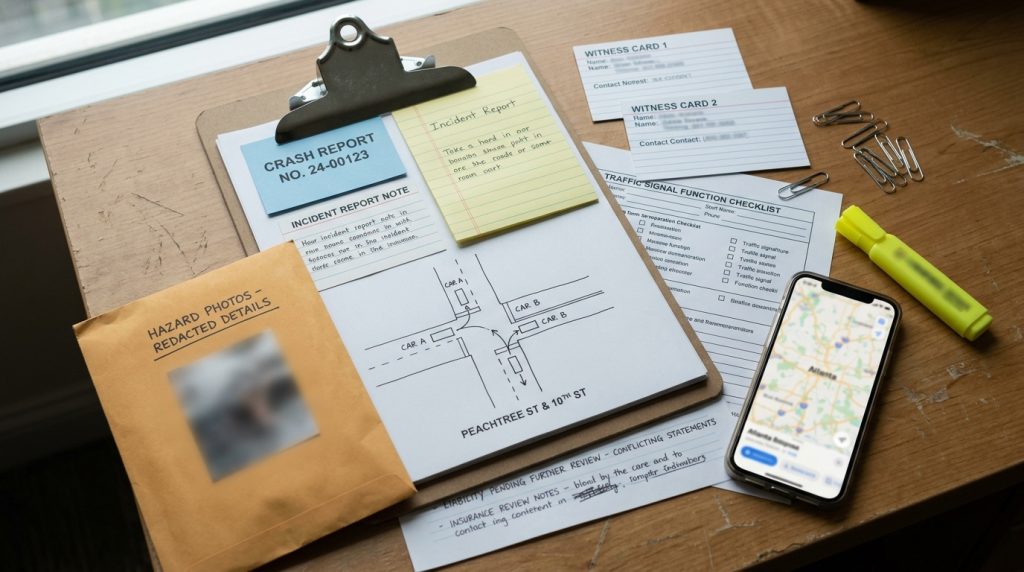
Official reports can help insurers understand what happened.
For motor vehicle crashes, the Georgia Motor Vehicle Crash Report, also known as GDOT-523, is the official document used by Georgia law enforcement agencies to collect and share crash data.
A crash report may document:
- Date and time
- Location
- Drivers
- Vehicles
- Insurance information
- Reported injuries
- Witness details
- Citations
- Contributing factors
- Officer observations
- Report number
For Atlanta crashes, the Atlanta Police Department’s Open Records Unit directs people seeking a single report to the Central Records Unit and provides accident-report access information.
For non-traffic injury claims, such as a fall at a store, hotel, apartment complex, parking garage, restaurant, or office building, an incident report may be important. Ask for a copy or at least write down who took the report, when it was made, and what was reported.
A report helps, but it is not the whole claim. Photos, videos, witness details, medical records, bills, repair estimates, insurance letters, and wage records may also matter.
Review Column 3: Photos, Videos, and Scene Evidence
Insurance companies often compare what people say with what physical evidence shows.
Useful scene evidence may include:
- Vehicle damage photos
- License plate photos
- Road layout photos
- Traffic sign photos
- Signal photos
- Crosswalk photos
- Skid mark or debris photos
- Weather and lighting notes
- Construction-zone photos
- Hazard photos
- Store aisle photos
- Parking-lot layout photos
- Stairway or floor-condition photos
- Surveillance camera locations
- Dashcam footage
- Witness names and phone numbers
Scene evidence is especially important when the insurer disputes fault, says injuries do not match the impact, questions the location, or argues that a property hazard was open and obvious.
Review Column 4: Medical Treatment Timeline
Insurance companies pay close attention to when medical care began and whether treatment was consistent.
They may ask:
- Did the injured person seek care the same day?
- Was there an emergency room visit?
- Was urgent care needed?
- Were symptoms reported clearly?
- Did the medical records mention the accident?
- Did the person follow up with recommended care?
- Were there gaps in treatment?
- Were appointments missed?
- Did symptoms change over time?
- Were referrals followed?
- Were future treatment needs documented?
Treatment gaps can create disputes. The insurance company may argue that the injuries were not serious, were unrelated to the accident, or were caused by something else.
Save records from:
- Emergency medical services
- Emergency rooms
- Urgent care clinics
- Primary care doctors
- Orthopedic specialists
- Neurologists
- Imaging centers
- Physical therapy providers
- Pharmacies
Also save:
- Medical bills
- Prescription receipts
- Imaging reports
- Discharge instructions
- Referral paperwork
- Work restriction notes
- Therapy attendance records
- Follow-up appointment summaries
Review Column 5: Medical Bills and Prognosis
Medical bills matter, but the insurer may not accept every charge without review.
The insurer may look at:
- Diagnosis
- Treatment dates
- Provider notes
- Whether treatment relates to the accident
- Whether treatment appears necessary
- Whether treatment was consistent
- Whether bills appear supported
- Whether there were prior similar injuries
- Whether future care is documented
- Whether the injured person reached maximum medical improvement
- Whether there are permanent limitations
For accident and health claims, the Georgia Office of Commissioner of Insurance advises claimants to ask a physician to provide the insurer with details about treatment, medical conditions, and prognosis.
That matters because a stack of bills alone may not explain the full injury. Medical notes can show symptoms, diagnosis, treatment plan, restrictions, recovery progress, and future-care concerns.

Review Column 6: Lost Wages and Earning Impact
Insurance companies usually require documentation before considering lost income.
Useful wage records may include:
- Pay stubs
- Timesheets
- Employer letters
- Missed-shift confirmations
- Work restriction notes
- Tax records
- Contractor invoices
- Business income records
- Schedule changes
- Reduced-duty notes
- Proof of used sick time or vacation time
If the injury affects future earning ability, more documentation may be needed. That may include medical restrictions, job descriptions, income history, employer statements, and evidence showing how the injury limits work duties.
A recovery journal can also help document daily-life impact. Keep it factual. Track pain levels, sleep problems, mobility limits, headaches, anxiety while driving, difficulty working, missed activities, medication side effects, and changes to family routines.
Review Column 7: Vehicle Damage, Repairs, and Property Loss
In car accident claims, insurance companies often compare injuries with vehicle damage. They may argue that low visible damage means the injury should be minor. That argument is not always fair, but it is common.
Save:
- Vehicle damage photos
- Repair estimates
- Supplemental repair estimates
- Body shop invoices
- Total-loss valuation paperwork
- Rental car receipts
- Towing receipts
- Storage bills
- Photos of damaged personal property
- Communications with repair shops
- Communications with insurers
For property-related injury claims, save:
- Hazard photos
- Incident reports
- Store or property communication
- Repair or maintenance notes, if available
- Camera-location notes
- Witness information
- Receipts showing you were there
The Georgia Office of Commissioner of Insurance recommends keeping a record of time and expenses and not letting bills or receipts pile up. That advice fits both vehicle-damage and injury-claim organization.
Review Column 8: Available Coverage and Policy Limits
A claim may be worth more than the available insurance. Policy limits can affect the insurer’s evaluation and settlement strategy.
Insurance coverage may include:
- At-fault driver liability coverage
- Commercial insurance, if a company vehicle was involved
- Rideshare coverage, if applicable
- Uninsured motorist coverage
- Underinsured motorist coverage
- Medical payments coverage
- Collision coverage
- Rental coverage
- Health insurance
- Property insurance, in some premises claims
- Excess or umbrella coverage
Georgia requires minimum auto liability insurance for drivers on public roads and highways. The minimum bodily injury liability limits are commonly stated as $25,000 per person and $50,000 per incident, with minimum property damage coverage also part of Georgia’s required coverage framework.
Minimum coverage may not be enough after a serious injury. Emergency care, surgery, therapy, missed work, long-term pain, and future medical needs can quickly exceed a small policy.
Review Column 9: Statements, Consistency, and Credibility
Insurance companies review consistency across the file.
They may compare:
- Police reports
- Medical records
- Claim forms
- Recorded statements
- Repair notes
- Witness statements
- Social media posts
- Prior medical records
- Earlier texts or emails about the accident
Be careful with:
- Recorded statements
- Broad medical authorizations
- Quick settlement calls
- Social media posts
- Texts about the accident
- Casual comments to adjusters
- Guessing about facts you do not know
Avoid guessing about speed, distance, timing, visibility, fault, injury severity, or future medical needs. If you do not know something, say you do not know.
The Georgia Office of Commissioner of Insurance advises drivers not to make oral or written statements about responsibility or blame after a crash.
Review Column 10: Settlement Releases
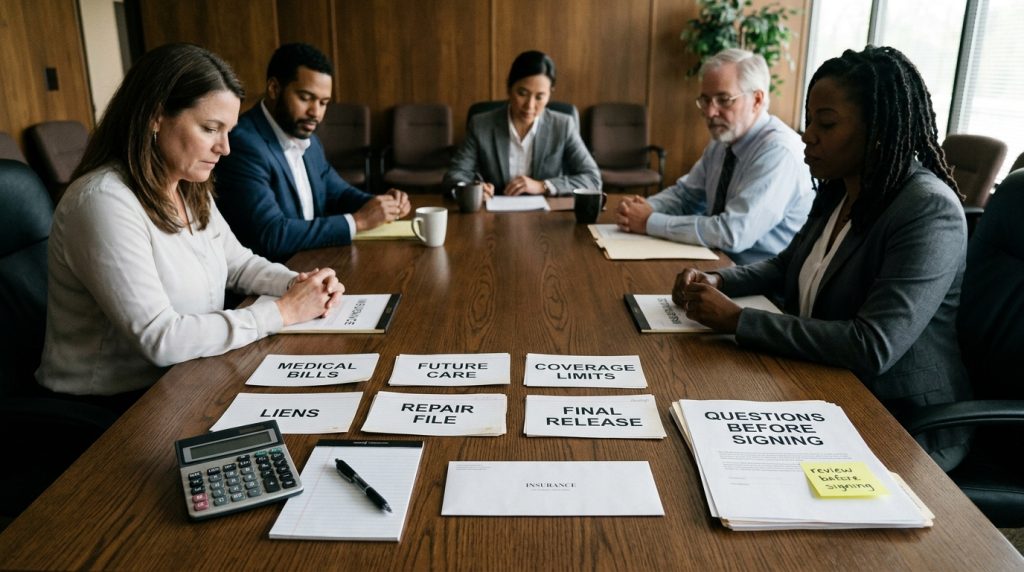
A settlement release is one of the most important documents in an injury claim. It usually ends the claim in exchange for payment.
Before signing, ask:
- Are all medical bills included?
- Is treatment complete?
- Is future care expected?
- Are lost wages included?
- Are repair or rental issues separate?
- Are liens or reimbursement claims possible?
- Does the release include all claims?
- Does it release only one party or multiple parties?
- Does it include unknown injuries?
- Is the payment final?
- Are you still treating?
A quick settlement may not include future medical care, lost earning ability, long-term symptoms, or complications that become clearer later.
Common Reasons Insurers Reduce or Deny Georgia Injury Claims
Insurance companies may reduce or deny claims for many reasons.
Common arguments include:
- Their insured was not at fault.
- You were partly responsible.
- There is not enough evidence.
- Injuries were not caused by the accident.
- Medical treatment was delayed.
- Treatment was inconsistent.
- Bills were too high.
- Treatment was unnecessary.
- Injuries were pre-existing.
- Vehicle damage was minor.
- Witnesses are missing.
- Statements are inconsistent.
- Policy limits are low.
- Coverage does not apply.
- A release was already signed.
A strong claim file anticipates these arguments and answers them with records.
Atlanta Accident Context That May Affect Evaluation
Atlanta injury claims may involve:
- I-75
- I-85
- I-20
- I-285
- GA-400
- Downtown Connector
- Peachtree Street
- Ponce de Leon Avenue
- Moreland Avenue
- Northside Drive
- Memorial Drive
- Downtown and Midtown intersections
- Buckhead traffic
- MARTA-adjacent travel areas
- Airport-area routes
- Campus and hospital-area streets
- Event and hotel districts
- Rideshare pickup zones
- Delivery and commercial vehicle routes
- Retail parking lots
- Apartment complexes
- Restaurants, hotels, and grocery stores
The setting affects the evidence. A freeway crash may depend on lane-change details, dashcam footage, tow records, and crash reports. A downtown pedestrian injury may involve crosswalk photos, business cameras, and witnesses. A store injury may involve incident reports, cleaning records, surveillance footage, and hazard photos.
Atlanta’s Vision Zero program uses a systems-based approach to eliminate traffic deaths and serious injuries through safer street design, speed management, and other strategies. That local safety context does not prove fault in a specific claim, but it reinforces why location, speed, road design, lighting, intersections, transit use, and vulnerable road users may matter.
Georgia Deadlines and Shared-Fault Rules
Georgia injury claims are time-sensitive. In many cases, actions for injuries to the person must be brought within two years after the right of action accrues under Georgia Code Section 9-3-33.
That does not mean you should wait. Insurance evaluations can take time, medical records may take weeks to collect, witnesses may become harder to contact, and camera footage may be overwritten.
Georgia law can also affect recovery when fault is disputed. Under Georgia Code Section 51-12-33, a plaintiff is not entitled to damages if the plaintiff is 50 percent or more responsible for the injury or damages claimed.
Because insurance companies may use fault arguments to reduce claim value, evidence is especially important.
What Records Should You Send to the Insurance Company?
Insurance companies may ask for records, but you should be careful about what you send and when.
Useful records may include:
- Crash report or incident report
- Photos of the scene
- Vehicle damage photos
- Hazard photos
- Witness information
- Medical records related to the accident
- Medical bills
- Repair estimates
- Rental receipts
- Towing receipts
- Wage records
- Work restriction notes
- Out-of-pocket expense receipts
Be careful with broad medical authorizations. A broad authorization may allow an insurer to request unrelated medical history. Ask what records are needed and whether the request is limited to the injury claim.
When Legal Guidance May Be Useful
Not every injury claim requires a lawyer. However, legal guidance may be useful when the insurance evaluation becomes difficult, unfair, or confusing.
Consider speaking with a lawyer if:
- You needed emergency care
- You were hospitalized
- Medical treatment is ongoing
- The insurer disputes fault
- The insurer says you were partly responsible
- The insurer questions your medical treatment
- The insurer asks for a recorded statement
- The insurer requests broad medical authorizations
- The insurer delays or denies the claim
- The settlement offer seems too low
- The at-fault driver has no insurance
- The at-fault driver has low policy limits
- A commercial vehicle or rideshare vehicle was involved
- You missed work
- Future medical care may be needed
- The injury happened at a business or apartment complex
- Camera footage may need to be preserved
- A loved one suffered a fatal injury
A lawyer may help organize evidence, communicate with insurers, evaluate damages, preserve records, respond to disputes, and explain Georgia deadlines.
Georgia Injury Claim Evaluation Checklist
Use this checklist to strengthen the claim file.
Liability Evidence
- Crash report or incident report
- Scene photos
- Vehicle damage photos
- Hazard photos
- Road layout photos
- Traffic signal or sign photos
- Witness names and phone numbers
- Dashcam or nearby camera notes
Medical Evidence
- Emergency care records
- Urgent care records
- Imaging reports
- Specialist notes
- Therapy records
- Medical bills
- Prescription receipts
- Work restriction notes
- Future care recommendations
Financial Evidence
- Repair estimates
- Rental receipts
- Towing and storage records
- Pay stubs
- Timesheets
- Employer letters
- Out-of-pocket receipts
- Recovery journal notes
Insurance Evidence
- Claim numbers
- Adjuster contact information
- Insurance letters
- Policy-limit information
- Recorded statement requests
- Medical authorization requests
- Settlement offers
- Denial letters
Before Signing
- Confirm treatment status
- Ask about future care
- Review medical bills
- Review wage loss
- Review repair and rental issues
- Ask about liens or reimbursement claims
- Understand what the release covers
- Ask about Georgia deadlines
FAQ
How do insurance companies evaluate injury claims in Georgia?
They review fault, reports, photos, videos, witness statements, medical records, treatment timelines, medical bills, wage loss, repair records, prior injuries, statements, insurance coverage, policy limits, and settlement risk.
Why does the insurance company care when I first got medical treatment?
The insurer may use the treatment timeline to decide whether the injuries appear related to the accident. Delayed care or treatment gaps can create disputes.
Do medical bills automatically determine settlement value?
No. Medical bills are important, but insurers may also review treatment necessity, causation, injury severity, future care, policy limits, wage loss, and fault.
Can an insurance company use my recorded statement against me?
A recorded statement may be compared to other records. Guessing about speed, distance, timing, injuries, or fault can create problems later.
What if the insurance company says I was partly at fault?
Georgia law can reduce or bar recovery depending on the percentage of responsibility. Evidence such as photos, witnesses, reports, and video can become important.
Why does vehicle damage matter in an injury claim?
Insurers often compare claimed injuries with vehicle damage. Repair estimates, photos, supplemental damage records, and medical documentation may help explain the full impact of the crash.
Should I sign a medical authorization?
Be careful with broad medical authorizations. Ask what records are needed and whether the request is limited to treatment related to the accident.
Why is the settlement release important?
A release usually ends the claim. Before signing, consider medical bills, future care, lost wages, liens, property damage, and whether treatment is complete.
How long do I have to file a personal injury lawsuit in Georgia?
In many Georgia injury cases, the general deadline is two years after the right of action accrues. Some claims may involve shorter notice rules or different deadlines.
What if the at-fault driver’s insurance limits are too low?
Other coverage may need review, including uninsured/underinsured motorist coverage, medical payments coverage, health insurance, commercial coverage, rideshare coverage, or other available policies depending on the facts.
Is this article legal advice?
No. This article is for general informational purposes only. Anyone dealing with a specific injury claim should speak with a qualified legal professional about their situation.
Final Thoughts
Insurance companies evaluate Georgia injury claims by looking for proof. They review who was responsible, what records exist, how treatment unfolded, whether damages are documented, what coverage applies, and what arguments could reduce the claim.
The best way to protect yourself is to stay organized. Save records, keep communication factual, follow medical advice, track expenses, avoid signing releases too early, and ask questions before important deadlines pass.